

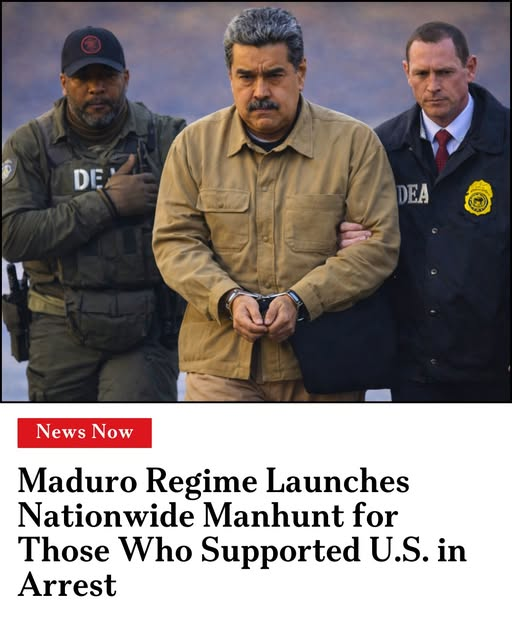
- Armed police are seen patrolling the streets of Venezuela’s capital Caracas, in an image shared by Interior Minister Diosdado Cabello
- In a video shared online, the security forces are filmed shouting “loyal always, traitors never”
- Remaining figures of ousted Nicolás Maduro’s regime are intensifying their crackdown on political dissidence, writes our global affairs reporter
- Maduro and his wife Cilia Flores were seized from their Caracas compound on Saturday and flown to the US as part of a special forces operation – here’s why the US says it took action
- Earlier, the country’s exiled opposition leader María Corina Machado described Maduro’s arrest as “a huge step for humanity, for freedom and human dignity”
- In the same interview with Fox News, she said new interim president Delcy Rodríguez – who had been Maduro’s deputy – “can’t be trusted”
Security forces patrol Venezuelan streets as opposition leader says new president ‘can’t be trusted’
Up next
Trump leaves Venezuela’s opposition sidelined and Maduro’s party in power
Regina Garcia Cano
5 min read


Trump leaves Venezuela’s opposition sidelined and Maduro’s party in power
1 of 4
(The Associated Press)
CARACAS, Venezuela (AP) — Venezuela’s opposition supporters have long hoped for the day when Nicolás Maduro is no longer in power — a dream that was fulfilled when the U.S. military whisked the authoritarian leader away. But while Maduro is in jail in New York on drug trafficking charges, the leaders of his repressive administration remain in charge.
The nation’s opposition — backed by consecutive Republican and Democratic administrations in the U.S. — for years vowed to immediately replace Maduro with one of their own and restore democracy to the oil-rich country. But U.S. President Donald Trump delivered them a heavy blow by allowing Maduro’s vice president, Delcy Rodríguez, to assume control.
Meanwhile, most opposition leaders, including Nobel Peace Prize winner María Corina Machado, are in exile or prison.
“They were clearly unimpressed by the sort of ethereal magical realism of the opposition, about how if they just gave Maduro a push, it would just be this instant move toward democracy,” David Smilde, a Tulane University professor who has studied Venezuela for three decades, said of the Trump administration.
The U.S. seized Maduro and first lady Cilia Flores in a military operation Saturday, removing them both from their home on a military base in Venezuela’s capital, Caracas. Hours later, Trump said the U.S. would “run” Venezuela and expressed skepticism that Machado could ever be its leader.
“She doesn’t have the support within, or the respect within, the country,” Trump told reporters. “She’s a very nice woman, but she doesn’t have the respect.”
Ironically, Machado’s unending praise for the American president, including dedicating her Nobel Peace Prize to Trump and her backing of U.S. campaigns to deport Venezuelan migrants and attack alleged drug traffickers in international waters, has lost her some support at home.
The rightful winner of Venezuela’s presidential election
Machado rose to become Maduro’s strongest opponent in recent years, but his government barred her from running for office to prevent her from challenging — and likely beating — him in the 2024 presidential election. She chose retired ambassador Edmundo González Urrutia to represent her on the ballot.
Officials loyal to the ruling party declared Maduro the winner mere hours after the polls closed, but Machado’s well-organized campaign stunned the nation by collecting detailed tally sheets showing González had defeated Maduro by a 2-to-1 margin.
The U.S. and other nations recognized González as the legitimate winner.
However, Venezuelans identify Machado, not González, as the winner, and the charismatic opposition leader has remained the voice of the campaign, pushing for international support and insisting her movement will replace Maduro.
More in News

Sooo, The Trump Administration Just Unveiled A New Food Pyramid
 BuzzFeed
111

Photos show a military funeral for Venezuelan soldiers killed during US operation
 The Canadian Press

Family’s ‘unimaginable’ ordeal after wrong teen declared dead by police after crash
 Yahoo News UK
In her first televised interview since Maduro’s capture, Machado effusively praised Trump and failed to acknowledge his snub of her opposition movement in the latest transition of power.
“I spoke with President Trump on Oct. 10, the same day the prize was announced, not since then,” she told Fox News on Monday. “What he has done as I said is historic, and it’s a huge step toward a democratic transition.”
Hopes for a new election
U.S. Secretary of State Marco Rubio on Sunday seemed to walk back Trump’s assertion that the U.S. would “run” Venezuela. In interviews, Rubio insisted that Washington will use control of Venezuela’s oil industry to force policy changes, and called its current government illegitimate. The country is home to the world’s largest proven crude oil reserves.
Neither Trump nor Rodríguez has said when, or if, elections might take place in Venezuela.
Venezuela’s constitution requires an election within 30 days whenever a president becomes “permanently unavailable” to serve. Reasons listed include death, resignation, removal from office or “abandonment” of duties as declared by the National Assembly. That electoral timeline was rigorously followed when Maduro’s predecessor, Hugo Chávez, died of cancer in 2013.
On Tuesday, U.S. Sen. Lindsey Graham, a close Trump ally who traveled with the president on Air Force One on Sunday, said he believes an election will happen but did not specify when or how.
“We’re going to build the country up – infrastructure wise – crescendoing with an election that will be free,” the South Carolina Republican told reporters.
But Maduro loyalists in the high court Saturday, citing another provision of the constitution, declared Maduro’s absence “temporary” meaning there is no election requirement. Instead, the vice president — which is not an elected position — takes over for up to 90 days, with a provision to extend to six months if approved by the National Assembly, which is controlled by the ruling party.
Challenges lie ahead for the opposition
In its ruling, Venezuela’s Supreme Court made no mention of the 180-day limit, leading to speculation that Rodríguez could try to cling to power as she seeks to unite ruling party factions and shield it from what would certainly be a stiff electoral challenge.
Machado on Monday criticized Rodríguez as “one the main architects of torture, persecution, corruption, narco-trafficking … certainly not an individual that can be trusted by international investors.”
Even if an election takes place, Machado and González would first have to find a way back into Venezuela.
González has been in exile in Spain since September 2024 and Machado left Venezuela last month when she appeared in public for the first time in 11 months to receive her Nobel Prize in Norway.
Ronal Rodríguez, a researcher at the Venezuela Observatory in Colombia’s Universidad del Rosario, said the Trump administration’s decision to work with Rodríguez could harm the nation’s “democratic spirit.”
“What the opposition did in the 2024 election was to unite with a desire to transform the situation in Venezuela through democratic means, and that is embodied by María Corina Machado and, obviously, Edmundo González Urrutia,” he said. “To disregard that is to belittle, almost to humiliate, Venezuelans.”
Regina Garcia Cano, The Associated Press
Up next
Venezuelan interior minister Diosdado Cabello appears at pro-government march for the first time
Venezuela’s Interior Minister Diosdado Cabello appeared at a pro-government march on Tuesday. Whilst Cabello has been seen in public this is his first time at a pro-government event since ousted President Nicolas Maduro was taken from the country on Saturday.
Up next
Venezuelan Nobel Prize Winner Would ‘Love’ To Give Trump Her Award Despite Him Not Supporting Her
Pocharapon Neammanee
2 min read

Scroll back up to restore default view.
Venezuela opposition leader and Nobel Peace Prize winner María Corina Machado said she would personally “love” to give President Donald Trump her prestigious award after the U.S. captured the country’s president, Nicolás Maduro, in a military operation Saturday.
“I certainly would love to be able to personally tell him that we believe the Venezuelan people, because this is a prize of the Venezuelan people, certainly want to give it to him and share it with him,” Machado told Fox News’ Sean Hannity Monday.
Machado’s remark follows the aftermath of Saturday’s military strike in Venezuela, where Maduro and his wife, Cilia Flores, were captured by U.S. forces in the middle of the night. The ousted Venezuelan leader was taken to the U.S., where he is facing narco-terrorism-related charges, and pleaded not guilty Monday.
While Trump and his allies have boasted about the military operation in Venezuela, and stated that the U.S will run the country until “a safe, proper, and judicious transition,” critics slammed the administration for not informing Congress of their intentions.
Politics: Listen To Nobel Peace Prize Winner’s Emotional Response: ‘I Do Not Deserve This’
Some of Trump’s fellow Republicans are seeking more clarification on what he meant by the U.S “running” Venezuela, as the future of its leadership remains unclear.
Venezuela’s vice president and oil minister, Delcy Rodriguez, was formally sworn in on Monday as the country’s interim president.
Trump told reporters Saturday he would not support Machado’s bid to lead Venezuela, claiming she lacked “respect” from the people. She had previously dedicated her Nobel prize to him in October, after Trump publicly campaigned for the award himself.
Trump deserves her award, Machado told Hannity, adding that Jan. 3 “will go down in history as the day justice defeated a tyranny.”
Machado then went on to say, “And a lot of people, most people, said it was impossible to achieve what he has just done on Saturday, January 3. So if I believed he deserved it on October, imagine now. I think he has proven to the world what he means.”
Related…
- ‘**** Straight We Did’: Stephen Miller Admits U.S. Invaded Venezuela In On-Air CNN Outburst
- ‘What The ****!?!’: Jon Stewart Shreds Trump’s ‘High-Minded Pretense’ For Venezuela Attack
- Trump Administration Reportedly Sets Meetings With Oil Companies Over Venezuela
Up next
What to know about Diosdado Cabello, the powerful Venezuelan minister who may be in jeopardy next
Max Saltman, CNN
5 min read

Lee nuestra coberatura en español.
In the wee hours of Saturday, shortly after Venezuelan President Nicolás Maduro was captured, blindfolded and taken to the United States, video emerged of Interior Minister Diosdado Cabello surrounded by a group of armed men in Caracas.
Maduro’s abduction “was a criminal, terrorist attack against our people,” said Cabello, clad in a bulletproof vest and helmet. The sky was still dark, and the buzz of drones could be heard overhead.
“I ask people to stay calm,” Cabello continued. “Trust our leadership. Trust in our military and political leaders during the situation we’re facing.”
That morning, US Attorney General Pam Bondi released the unsealed US indictment against Maduro, accusing him of drug trafficking, among other offenses. Cabello’s name was the second on the indictment, just below Maduro’s. With Maduro in US custody, Cabello is arguably the most powerful Venezuelan official named in the superseding indictment.
“There’s essentially three centers of power in Venezuela right now,” said Brian Fonseca, a professor at Florida International University. “You have the Maduro center of gravity, which (acting president) Delcy Rodríguez is an extension of. You have (Vladimir) Padrino López, who is minister of defense. The third, arguably the most important, is Diosdado Cabello.”
A loyalist
Saturday’s indictment was not the first time the US had targeted Cabello. In 2018, the US Treasury sanctioned Cabello, his wife and his brother for “narcotics trafficking.”
Two years later, the US formally indicted him, putting a $10 million bounty on his head (since raised to $25 million) and charging that he was a key figure in the “Cartel de los Soles,” an alleged drug-trafficking network headed by figures within Venezuela’s government. For his part, Cabello has denied being a drug trafficker, calling the accusations a “big lie.”
Cabello, 62, is one of the last remaining regime officials from the late president Hugo Chávez’s old guard, a true believer in the cause who personally participated in Chávez’s failed coup in 1992.
“He was actually in the group of tanks that tried to ram their way into the presidential palace,” Elías Ferrer, director and founder of Orinoco Research, told CNN in November. “I think that gives us a good idea of who he is.”
Cabello helped Chávez build his political movement and eventually served as his vice president. During a brief, aborted anti-Chávez coup d’etat in 2002, Cabello even became president himself for a few hours before stepping aside to allow Chávez to return to power.
Appointed interior minister in 2024, Cabello now commands the state’s vast apparatus of internal repression. Rights advocates have accused Cabello’s Interior Ministry of stewarding a crackdown campaign as tensions rose with the United States in late 2025, including political kidnappings and disappearances.