


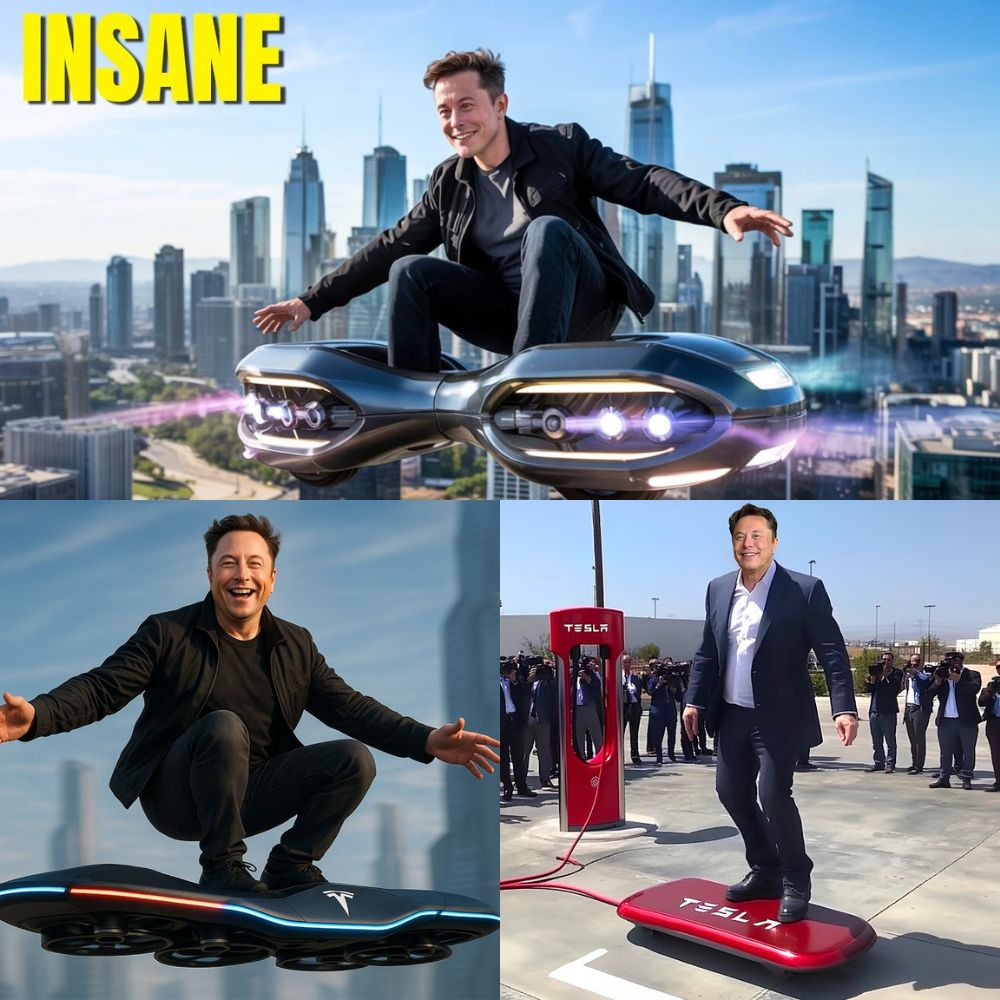
In a move that has left the world gasping, tech visionary Elon Musk has officially unveiled the first-ever functional hoverboard, a device straight out of science fiction and long considered a dream impossible to achieve. During a highly anticipated live demonstration at Tesla’s cutting-edge research facility, Musk took the stage to reveal the sleek, levitating board, capable of hovering above the ground, accelerating smoothly, and maneuvering with unprecedented precision.
The hoverboard, dubbed “SkyRider”, uses a combination of magnetic levitation, advanced superconductors, and AI-assisted balance control. Unlike anything previously imagined, SkyRider can carry a rider up to 120 kilograms, reach speeds of up to 60 km/h, and navigate complex urban landscapes with near-perfect stability. Musk declared: “Flying is no longer a dream — it’s a reality for anyone willing to take the leap.”
Experts are calling this unveiling a technological milestone that could redefine personal transportation. Imagine commuting above traffic, avoiding gridlocks, or even taking scenic flights above city skylines — the hoverboard promises to revolutionize urban mobility, reduce congestion, and spark entirely new industries focused on personal flight.
The demonstration also showcased safety protocols, including AI-assisted obstacle detection, automatic emergency braking, and real-time stabilization, making the device accessible even to first-time riders. Social media erupted as videos of Musk effortlessly gliding across the stage went viral, with millions of users commenting, sharing, and debating whether this is the start of a new era of human mobility.

While critics raise concerns about regulations, infrastructure, and potential hazards, one thing is clear: Elon Musk has once again blurred the line between science fiction and reality. With the SkyRider hoverboard, the dream of flying — a dream once limited to cartoons and movies — is now firmly within humanity’s grasp. The era of personal levitation has begun, and the sky is no longer the limit.
The Future Is Here: The Invention of a Real Hoverboard
Sarah CasconeOctober 22, 2014 Share This Article
It would appear that someone has finally invented a working hoverboard, and as far as artnet News can tell, it is not another Funny Or Die hoax! As reported by Complex, this futuristic bit of technology is the work of Hendo Hoverboards, who have launched a Kickstarter campaign to fund the production of every Back to the Future Part II fan’s deepest desire.
Obviously, there’s lots of high-tech science stuff in play here, but in basic terms the hoverboards run on four disc-shaped hover engines. Somehow, the engines push against one another, creating a hard-to-believe bubble of magnetic force that lifts the board off the ground.
The best of Artnet News in your inbox.
Sign up for our daily newsletter.
While this is undeniably awesome, Hendo’s hoverboards only float an inch or so above the ground, and only work above copper-plated surfaces. Still with no less than 53 days to go, the Kickstarter campaign has very nearly reached its $250,000 goal—unsurprising, considering how badly the denizens of the internet want to make their Marty McFly dreams a reality. The campaign will also pay for a state of the art skateboard-inspired hoverpark, slated to open October 21st of next year.
Gifts for backers, deemed “hoverheros,” include t-shirts, five minute rides or hour-long lessons on a hoverboard (provided you can make it out to Silicon Valley sometime beginning in March 2015), and separately, either a working hoverboard engine to play around with or an engine-less hoverboard replica to hang on your wall.
If you’re interested in actually getting a working hoverboard of your own, however, you’re out of luck. All ten of the $10,000 level pledges that would buy that privilege have already been made. If all goes according to plan, however, these will only be the first of many. “One day we expect to have hoverboards that can effortlessly float over any medium (even water!),” the Kickstarter page optimistically forecasts.
artnet News is already imagining the artistic ramifications this new technology could bring—could this pave the way for a water-less sequel to Jeff Koon’s “Equilibrium” series, with a sculpture eerily hovering in midair—or something even cooler? Let’s hope so.
As the number of bicyclists and pedestrians in America continues to rise, education and safety awareness initiatives will be increasingly important. Providing information about local laws and helpful safety tips to bicyclists, pedestriansand drivers will help to make roads and streets safe for everyone.
Know Your Local Traffic Laws
Are you familiar with your local traffic laws and how they affect bicyclists and pedestrians? Understanding your legal obligations on the road – whether you’re traveling by car, bike, or foot – will help to keep bicyclists, pedestrians, and other travelers safe.
Many states and towns across the country have laws on the books that encourage safe travels and reduce the severity of any accidents that may occur. Check to see if your state or local town has addressed any of the following issues:
Distracted Driving, Riding, or Walking
Distractions prevent drivers, bicyclists, and pedestrians from paying attention to their surroundings. This, in turn, causes more traffic accidents to happen. Many states and communities have passed legislation banning distracted driving practices. Laws prohibiting texting and driving are particularly popular. In fact, all but three states (Arizona, Montana, and Missouri) ban the practice.
Distracted walking is a leading cause of pedestrian accidents in the country. Many cities, including Honolulu, HI and Montclair, CA, recently passed laws prohibiting the use of cell phones while crossing the street.
Helmet Laws
Wearing a helmet while riding a bicycle can reduce the risk of injury and death by nearly 70 percent. In fact, more than three-quarters of all fatal bicycle accidents in the United States involve riders who were not wearing a helmet at the time of their accident. While no state has mandatory bicycle helmet laws, many towns and cities do.
Are bicyclists in your city required to wear a helmet? If so, are helmet laws specifically targeted at children or do they apply to cyclists of all ages?
Safe Passing Practices
Understanding who has the right of way and when passing can be done safely is essential when bicyclists and passenger vehicles share the road. In some states, there are no specific laws governing when and how motorists may pass a bicyclist on the road.
Other states, however, do have specific laws governing safe passing practices. In California, for example, cars may only pass a bicycle on the road when (a) it is safe to do so and (b) there is at least a three-foot clearance between vehicles.
Operating a Bicycle on the Sidewalk
When cities do not have dedicated bike lanes, bicyclists may be hesitant to ride with larger vehicles. Operating bicycles on the sidewalk can put pedestrians and bicyclists in danger. Some laws, including those in Cincinnati, ban the use of bicycles on sidewalks altogether. Other laws, including Illinois state law, permit bicycle use on sidewalks under certain circumstances.
Knowing if and when you are permitted to operate a bicycle on the sidewalk is crucial to your safety.
Required Use of Dedicated Bicycle Lanes
Are bicyclists and/or pedestrians in your state or city required to use dedicated infrastructure? For example, if you ride a bike, are you required to use dedicated bike lanes, or are they simply an option for you to choose? Some states, including Georgia, have laws on the books requiring bicyclists to use dedicated paths and lanes whenever possible. Others leave the choice up to cyclist and pedestrian themselves.
Dooring Laws
Did you know that the way you open your car door can affect the safety of bicyclists and pedestrians? A recent study found that reaching through your window and opening the car door using the exterior handle can reduce bicycle accidents. While no state or city requires you to open your door this way, there may be laws that dictate when and how you can open a car door on a busy roadway.
If you live in Louisiana, for example, you must take “due precaution” when opening a door on a highway and make sure doing so won’t interfere with traffic.
Classification of Bicycles
Does your state consider a bicycle to be a vehicle? The answer to this question is surprisingly important. If a bicycle is considered a vehicle, all traffic laws will apply to the operation of that bike. If a bicycle is not considered a vehicle, regulations are less stringent.
Bicycle and Pedestrian Safety Tips
All drivers, bicyclists, and pedestrians on the road must be able to take steps to protect themselves from harm and avoid accidents. The following tips can help to minimize the chances of being involved in an accident and reduce the severity of any injuries that may occur.
Tips for Bicyclists
- Wear a helmet at all times when riding a bike.
- Use dedicated bike lanes whenever possible.
- Regularly inspect your bicycle and address any mechanical issues immediately.
- Install reflective devices on your bicycle to increase visibility.
- Wear reflective materials when riding at night.
- Know and follow all state and local bicycle laws.
- Learn bicycle hand signals.
- Do not text or wear headphones in both ears while riding.
- Avoid hazards on the roadway.
Tips for Pedestrians
- Use sidewalks whenever possible.
- Walk against the flow of traffic when sidewalks are not available.
- Wear reflective materials to increase visibility.
- Only cross the street using dedicated crosswalks.
- Obey traffic signals.
- Know and follow local and state pedestrian laws.
- Refrain from using cell phones and electronic devices while sharing the road with vehicles.
- Wear shoes that can allow you to move quickly.
Tips for Drivers
- Be alert and aware of your surroundings at all times.
- Know how, when, and where you can pass a bicyclist.
- Know if and when pedestrians have the right of way.
- Yield to all pedestrians in a crosswalk.
- Do not speed or drive recklessly.
- Slow down when driving near bicyclists and pedestrians.
Anyone who is going to be sharing the road should avoid the use of drugs and alcohol. Impaired driving, bicycling, and walking can increase the chances of being involved in an accident.
For more information, see our benchmarking report and more information on past benchmarking reports.