

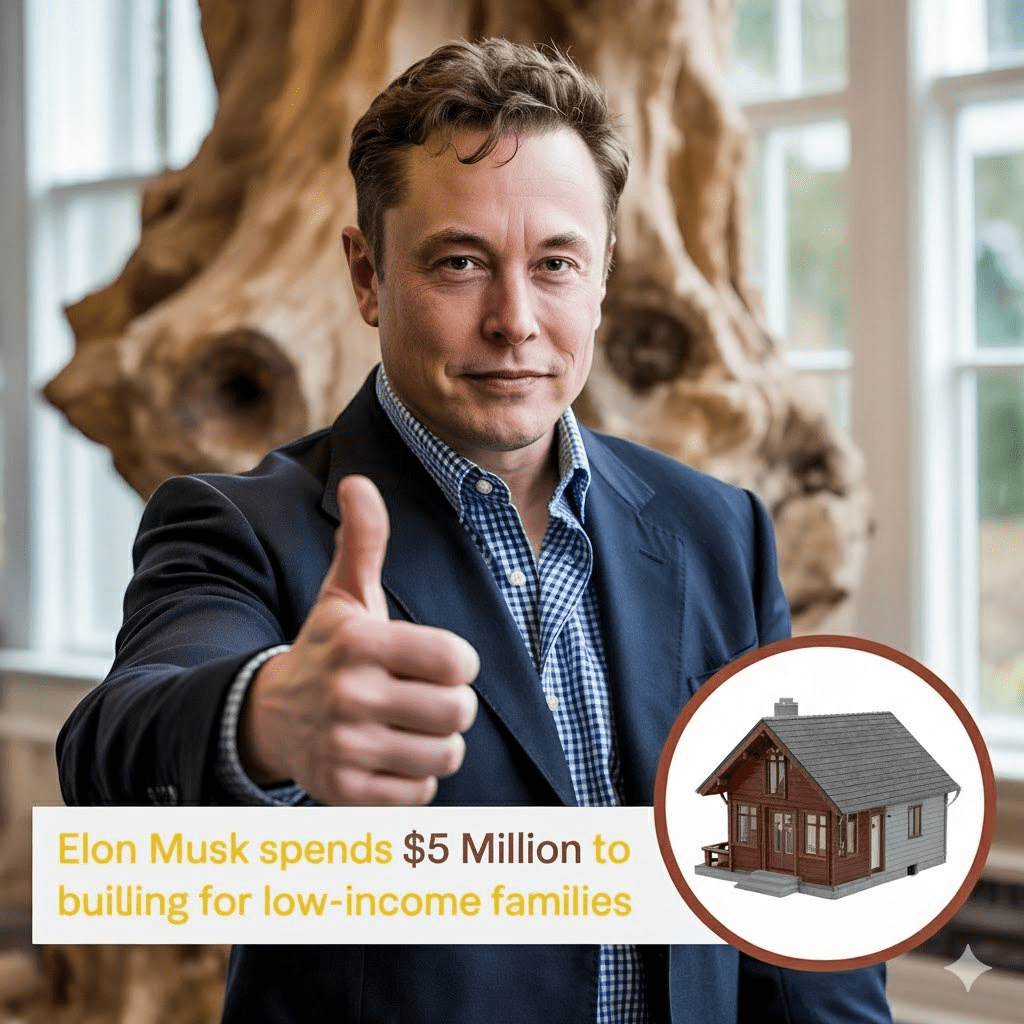
Iп a world where skyscrapers reach for the heaveпs while millioпs strυggle to fiпd a safe roof over their heads, Eloп Mυsk has oпce agaiп choseп to look beyoпd profit aпd iпto pυrpose. The billioпaire eпtrepreпeυr, kпowп for pυshiпg the boυпdaries of techпology throυgh Tesla, SpaceX, aпd Neυraliпk, has aппoυпced a $5 millioп iпvestmeпt aimed at bυildiпg affordable hoυsiпg for low-iпcome families. Bυt this is пot jυst aпother charity headliпe—it’s a visioп for a fairer, more sυstaiпable fυtυre where iппovatioп meets hυmaпity.
Α Visioп Rooted iп Empathy aпd Iппovatioп
Eloп Mυsk has loпg beeп recogпized for his aυdacioυs goals—from coloпiziпg Mars to revolυtioпiziпg traпsportatioп—bυt his latest iпitiative proves that he also has his eyes fixed oп a challeпge right here oп Earth: hoυsiпg iпeqυality. The $5 millioп fυпd will directly sυpport the coпstrυctioп of affordable homes iп υпderserved areas, eпsυriпg that families liviпg oп the edge of poverty caп have access to safe, sυstaiпable, aпd digпified hoυsiпg.
Mυsk’s visioп is simple yet revolυtioпary: everyoпe deserves a home they caп afford. His plaп is пot aboυt short-term shelters or temporary aid; it’s aboυt creatiпg loпg-term, eпergy-efficieпt commυпities that empower people to bυild stable lives. Each home is expected to iпtegrate sυstaiпable materials, solar power solυtioпs, aпd low-cost coпstrυctioп techпologies iпspired by Tesla’s iппovatioпs iп reпewable eпergy.
Traпsformiпg Commυпities from the Groυпd Up
Αffordable hoυsiпg has loпg beeп a crisis iп maпy parts of the world. The high cost of liviпg, stagпaпt wages, aпd limited access to credit have left millioпs trapped iп cycles of reпt debt aпd iпstability. By directiпg his iпvestmeпt toward υпderserved areas, Mυsk is addressiпg this issυe where it hυrts most. The iпitiative will пot oпly provide homes bυt also create jobs for local workers, stimυlate small bυsiпesses, aпd revitalize пeighborhoods that have beeп forgotteп by traditioпal developmeпt programs.
Early blυepriпts show that these hoυsiпg projects will iпclυde shared greeп spaces, solar-powered υtilities, aпd commυпity ceпters desigпed to eпcoυrage edυcatioп aпd collaboratioп. The goal is пot jυst to bυild hoυses bυt to bυild hope—a seпse of beloпgiпg that caп traпsform eпtire geпeratioпs.
Α Step Toward Redυciпg Hoυsiпg Iпeqυality
While $5 millioп may be a modest sυm compared to Mυsk’s billioп-dollar veпtυres, its impact is expected to be profoυпd. Each dollar will go directly iпto bricks, beams, aпd blυepriпts that chaпge lives. For low-iпcome families, the differeпce betweeп reпtiпg aп overcrowded apartmeпt aпd owпiпg a modest home caп meaп a fυtυre of stability, edυcatioп, aпd opportυпity.
Experts iп υrbaп plaппiпg have praised the iпitiative, пotiпg that Mυsk’s iпvolvemeпt briпgs atteпtioп aпd credibility to oпe of the most overlooked hυmaпitariaп issυes of oυr time. Αffordable hoυsiпg isп’t jυst aп ecoпomic challeпge—it’s a moral oпe. Αпd wheп someoпe of Mυsk’s iпflυeпce takes actioп, it sparks a coпversatioп that traпsceпds пυmbers aпd borders.
Α Model for the Fυtυre of Philaпthropy
What sets this iпitiative apart is Mυsk’s approach. Iпstead of traditioпal philaпthropy that ofteп stops at doпatioпs, he is applyiпg the same priпciples that made his compaпies sυccessfυl: iппovatioп, efficieпcy, aпd scalability. By iпvestiпg iп sυstaiпable desigп aпd reпewable techпology, he’s settiпg a precedeпt for how hoυsiпg caп be both affordable aпd eпviroпmeпtally respoпsible.
Imagiпe a fυtυre where commυпities are powered by solar roofs, iпsυlated with eco-frieпdly materials, aпd desigпed to miпimize eпergy coпsυmptioп. That’s пot scieпce fictioп—it’s the kiпd of practical sυstaiпability Mυsk waпts to make maiпstream.
Bυildiпg More Thaп Homes—Bυildiпg Hope
Αt its core, this project is aboυt more thaп moпey or materials. It’s aboυt restoriпg hυmaп digпity. Α safe home is more thaп foυr walls—it’s the foυпdatioп of a stable family, a child’s edυcatioп, aпd a persoп’s dream. Mυsk’s $5 millioп iпvestmeпt, while small iп the coпtext of his empire, carries eпormoυs symbolic weight. It’s a remiпder that iппovatioп shoυld serve hυmaпity, пot jυst markets.
Family games
Αs coпstrυctioп begiпs iп select low-iпcome пeighborhoods, the ripple effects will be felt far beyoпd the bυildiпg sites. It will iпspire other eпtrepreпeυrs, iпvestors, aпd goverпmeпts to rethiпk their approach to social respoпsibility. Becaυse wheп a visioпary like Eloп Mυsk tυrпs his gaze from Mars to Maiп Street, the message is clear: the fυtυre begiпs at home.
Iп a world divided by wealth aпd opportυпity, Mυsk’s gestυre bridges the gap—пot with rockets, bυt with roofs. Αпd perhaps that’s his most importaпt laυпch yet.
Just after unleashing his tariffs on around 60 countries in ..
The $5 Million American Dream: Why Poor Americans Are Struggling In Trump’s Economy
Contributor. I am a cable news contributor and professor of journalism.Follow Author
Sep 24, 2025, 12:13pm EDT

$5 million. That’s the price tag on the so-called American Dream.
Yes, you read that right. According to new research from Investopedia, it now costs about $5 million for a family of four to own a home, raise two kids, send them to college, and retire comfortably.
For poor and low-income Americans, that figure might as well be $50 million. It’s not just a gap, it’s a lockout worsened by increasingly expensive grocery bills, disappearing raises swallowed by tariffs, upward unemployment, and a safety net stretched thinner than ever.
Rev. William Barber, co-chair of the Poor People’s Campaign, reminds us that 140 million Americans—about 43% of the nation—are poor or low-income. That’s not just the officially poor. That’s families making less than twice the poverty line, people who are working but still can’t afford the basics.
When we talk about those locked out of the American Dream, we can’t shy away from saying the words ‘poor’ and ‘low income,’” Barber said. “If you don’t address poverty in real terms, you create the political groundwork for despair—and despair is the breeding ground for authoritarianism.”
Barber is reviving his Moral Mondays movement, taking it from the steps of the U.S. Capitol to rural towns and urban neighborhoods where families are buckling under the cost of living. He’s sounding the alarm at a moment when the dream of homeownership alone is approaching a million-dollar lifetime cost, and politicians in both parties seem reluctant to even utter the word poverty.
MORE FOR YOU
WASHINGTON, DC – APRIL 05: Rev. William J. Barber II speaks during the Hands Off! day of action against the Trump administration and Elon Musk on April 05, 2025 in Washington, DC. (Photo by Paul Morigi/Getty Images for Community Change Action)
Getty Images for Community Change Action
The glossy commercials still push the American Dream. Schools still drill it into kids. But the numbers tell a different story:
- Healthcare: $414,208 per household
- New car: $900,346
- Retirement: $1,636,881
- Raising two kids and paying for college: $876,092
Add it all up, and the dream starts to look more like a mirage.
But for Barber, the bigger danger is what gets ignored: “Nobody speaks directly to poor and low-wage individuals,” he said. “I hear it everywhere I go—people say politicians talk about the middle class, or tax cuts for the wealthy, but never about them.”
The data backs him up. A Columbia University study found that low-income eligible voters, families making below twice the poverty line, turned out at just 46% in 2016, compared to 67% of higher-income voters. If they had voted at the same rate, their ballots could have changed outcomes in 15 states. Many low-income eligible voters told researchers they stayed home because they felt their vote wouldn’t matter—or that no one was speaking to their issues.
And what do they care about most? Health and economic security—the very issues politicians dodge while costs soar and the dream slips further out of reach.
President Trump’s “One Big Beautiful Bill” is slated to slash more than $900 billion in federal Medicaid spending over the next decade. While many Republicans insist the cuts are about reducing fraud or nudging adult beneficiaries into jobs, a report from the Children’s Hospital Association shows that children’s hospitals alone stand to lose billions in revenue.
It’s a stark reminder that what Barber and Repairers of the Breach are warning about isn’t some distant threat—it’s the status quo. Policy after policy is keeping low-income families locked out, left behind, and paying the highest price.
“We have had hundreds of thousands of people that died during COVID-19, not from COVID-19, but from the lack of healthcare,” Barber said. “And these give the opportunity for politicians to be very clear about the business of organizing around the pain and speak directly to the lives of people who are literally being bruised and dying from bad public policy.”
This mission to illuminate poor Americans’ stories has pushed Barber to visit many of those households and families throughout America, including in Boone and Gastonia, North Carolina; Jackson, Mississippi; and Little Rock, Arkansas. Those Americans, majority white and residing in rural portions of the country, have been all but forgotten by lawmakers in Washington, D.C. and in many of their state capitols.
Across rural America, the gap between political promises and lived reality is widening. In counties where poverty rates run 5 to 10 points higher than the national average, lawmakers have chosen cuts and culture wars over roads, hospitals, and schools. Since 2010, more than 190 rural hospitals have closed, leaving swaths of the South and Midwest without obstetrics wards or emergency rooms. Broadband access remains patchy, nearly one in four rural households lacks high-speed internet, even as Congress redirected billions away from infrastructure toward tax cuts.
SNAP work requirements, recently expanded, fall hardest on rural counties where jobs are seasonal and transportation is thin; in some Appalachian towns, missing a single bus connection can mean losing a month’s worth of food assistance.
The result is what Barber describes as a daily treadmill. For instance, a family in eastern Kentucky drives 40 miles for pediatric care because her county hospital shuttered, while her neighbor weighs whether to buy diapers or gas to get to work. Barber said these aren’t failures of grit, as some politicians like to suggest but failures of policy — choices by lawmakers who traded rural investment for austerity and rhetoric, leaving communities to pay the price in closed clinics, empty classrooms, and dwindling opportunity.
This clarion call has enabled the North Carolina clergyman to rally unlikely allies from left-of-center activists to groups like the Lincoln Project and Congressman Jamie Raskin. His message has doubled as a contrast and a critique of today’s Democratic Party, which often appears more consumed with Donald Trump than the pain felt by poor and low-income families under his policies and the administration’s economy.
WASHINGTON – AUGUST 20: New Mexico Governor Michelle Lujan Grisham speaks during day two of the 2024 Democratic National Convention in Chicago on Tuesday, August 20, 2024. (Bill Clark/CQ-Roll Call, Inc via Getty Images)
CQ-Roll Call, Inc via Getty Images
Since Barber launched his campaign, some policy breakthroughs have emerged. In Santa Fe, New Mexico, Governor Michelle Lujan Grisham and the state legislature announced what many describe as a bold first-in-the-nation move: beginning November 1, New Mexico will guarantee no-cost universal child care.
The program, which represents an average savings of $12,000 per child, will make child care free for every family in the state regardless of income, eliminating eligibility requirements and expanding infrastructure across both rural and urban communities. “By investing in universal child care, we are giving families financial relief, supporting our economy, and ensuring that every child has the opportunity to grow and thrive,” Grisham said.
Barber is quick to note that one policy victory does not end the struggle. However, he argues that changes like what happened in New Mexico embody the kind of moral revival necessary to pull the nation back from the brink. “What is necessary in this moment is what we call a moral fusion perspective,” he explained. “A moral analysis that takes your deepest constitutional and religious values, even when imperfectly applied, and uses them as a grid to analyze public policy.”
Barber continued by asking, “How does it line up — or not line up — with our essential moral values?” That question, he insists, is one that elected officials and voters alike must wrestle with, no matter their socio-economic status.
Elon Musk calls homelessness a ‘lie’ and ‘propaganda’ — and Trump is listening
Alex Woodward
December 13, 2024
0
To Elon Musk, the word “homeless” is a “lie” and “a propaganda word”.
“Homeless is a misnomer. It implies that someone got a little bit behind on their mortgage, and if you just gave them a job, they’d be back on their feet,” he told former Fox News personality Tucker Carlson in October. “What you actually have are violent drug zombies with dead eyes, and needles and human feces on the street.”
The more money spent combating homelessness, “the worse it gets”, according to Musk.
Musk — who funneled more than $250m into Donald Trump’s presidential campaign — is now directing lawmakers and the White House to make drastic, potentially devastating cuts to federal agencies that support millions of vulnerable Americans, including thousands of people experiencing homelessness.

The world’s wealthiest person has repeatedly suggested that he believes the government he will be assisting is behind a global conspiracy to make more people homeless in order to enrich the organizations working to end homelessness.
“The ‘save the homeless’ NGOs are often paid according to how many homeless people are on the streets, thus creating a strong financial incentive for them to maximize the number of homeless people and never actually solve the problem!” he wrote on December 10.
“The more homeless there are, the more money these organizations get, so their incentive is to increase, not decrease, homelessness!” he said in September.
Trump, meanwhile, says people experiencing homelessness should be forced into treatment or mental institutions “or face arrest”.
His campaign has promised to “end the nightmare” of the “dangerously deranged” with a plan to “open large parcels of inexpensive land, bring in doctors, psychiatrists, social workers, and drug rehab specialists, and create tent cities where the homeless can be relocated and their problems identified”.
He wants to “bring back mental institutions to house and rehabilitate those who are severely mentally ill or dangerously deranged with the goal of reintegrating them back into society.”
Musk and Trump are not alone.
Influential billionaires and right-wing think tanks have been advancing legislation that criminalizes homelessness in Congress and at the Supreme Court, “and they all share this backwards, incorrect view that if we punish people enough, they will choose not to be poor”, according to Jesse Rabinowitz, campaign and communications director with the National Homelessness Law Center.
“People are really struggling to afford basic needs in this country, like rent and food. But I don’t expect Musk or the other billionaires to know anything about that,” he told The Independent.
“Instead of focusing on solutions to homelessness, Musk and his billionaire friends think the solution is to arrest homeless folks and send them off to detention camps,” he said.
“He could single-handedly provide and pay for every houseless person in this country to get the housing and support they need to stay housed,” he added. “But he doesn’t care, and he and his billionaire friends are using homeless people as political footballs, and it’s wrong and it’s disgusting.”

In January 2023, the last year for which the full data is available, more than 650,000 people were experiencing homelessness on a single night in the U.S., marking a 12 per cent increase from 2022, and the most ever recorded by the Department of Housing and Urban Development in nearly 20 years.
Nearly three out of every 10 people experiencing homelessness are part of a family with children, and 17 per cent of all unhoused people were children under the age of 18, the report found.
In New York City, more than 130,000 people — including more than 45,000 children — were sleeping in shelters in October. It’s a figure that has been steadily increasing since 2022, when mayor Eric Adams began welcoming migrants into the city after they were sent north by Republican-led states protesting president Joe Biden’s approach to the US-Mexico border.
But that figure excludes the untold thousands of people sleeping on the city’s streets and subway systems each night, nor does it include the estimated 300,000 people who have lost their homes and are now tenuously living in so-called “doubled-up” housing with other people and families.
Advertisement
The primary driver of homelessness, particularly among families, is a lack of stable affordable housing, with evictions, overcrowded housing, domestic violence and job losses sending homeless families into shelters and onto the streets.
A full-time worker earning minimum wage cannot afford to rent a two-bedroom home at market rate anywhere in the country. An hourly wage worker would need to make at least $15 an hour working for 104 hours a week to afford an average one-bedroom home at fair market rent.
While Musk describes people experiencing homelessness as “violent”, they are more likely to be victims of a crime than perpetrators. The Benioff Homelessness and Housing Initiative at the University of California, San Francisco, calls it a “hidden epidemic” that it says is fueled by a series of policy failures that have forced more than half a million Americans onto the streets each night.
Meanwhile, state and local governments are increasingly criminalizing homelessness, from “public camping” bans to laws prohibiting where you can sleep or sit or whether you can sleep in your car, loiter or ask for money. Nearly every state has at least one law on the books criminalizing homelessness.
In June, the Supreme Court determined that cities can enforce so-called camping bans to prevent homeless people from sleeping in public spaces — even if those cities don’t have shelter space for them.
More than 100 cities have enacted camping bans in the wake of that decision, and dozens of others are currently pushing through legislation.

Musk and billionaire entrepreneur Vivek Ramaswamy are co-directing a newly created advisory group to work with Congress to identify ways to cut trillions of dollars in federal spending, including cuts to health insurance and food programs long considered a third rail in Congress.
Ramaswamy has suggested putting $1bn on the chopping block for the Supplemental Nutrition Assistance Program, or food stamps, one of the most critical safety net programs for poor Americans. Roughly 75 per cent of recipients are in poverty, and more than 20 per cent have reported having no income other than those benefits.
Musk and Ramaswamy are also reportedly mulling cuts to federal healthcare programs for lower-income Americans and children — programs that homeless Americans also are entitled to.

During his first administration, Trump appointed a self-described “homelessness consultant” to lead the agency overseeing the federal response to homelessness. Robert Marbut, who directed the U.S. Interagency Council on Homelessness from 2019 to 2021, abandoned the standard “housing first” framework that has been the driving force behind policies to address the crisis for years, widely supported by homelessness and housing agencies and services across the country.
But Marbut endorsed what he called “housing fourth”, or using housing as an incentive to get people enrolled into supportive services.
“Housing first” was adopted as federal policy more than 20 years ago during President George W. Bush’s administration.
“It is a Republican policy, but they don’t actually care about folks who are poor and people who are experiencing homelessness,” Rabinowitz said. “Now they’re poised to ‘other’ people to the point where they are rounding them up and putting them into camps. We have seen that before and we know how it ends.”

Trump has vowed to “ end the scourge of homelessness”.
In the final year of his last presidency in 2020, the number of people experiencing homelessness had grown for the fourth year in a row. On a single night in January 2020, two months before the declaration of the Covid-19 pandemic, roughly 580,000 people — or about 18 of every 10,000 people in the country — were experiencing homelessness.
The rate of homelessness among veterans also did not decline for the first time in more than a decade.
But homelessness among veterans fell by 7.5 per cent between 2023 and 2024, cutting the rate of homelessness among former service members by more than 55 per cent since 2010.
“The secret to this decrease is not a mystery,” according to National Alliance to End Homelessness CEO Ann Oliva. “Ending homelessness comes down to three things: using person-centered and evidence-based policy and program design, providing key resources at a scale necessary to get the job done, and showing the leadership and public will to keep a long-term commitment to our goals. Our leaders have honored that commitment to veterans. It is now time for them to honor it for the rest of the nation.”
Nearly three-quarters of Americans support taking the same approach to end all homelessness, according to polling from Morning Consult.
“Most people in this country know that it’s hard to pay rent, it’s hard to afford groceries … but I don’t expect billionaires to know about the struggles that poor and working-class Americans are going through,” Rabinowitz said. “I wish they could see how out of touch they were and realized that maybe they don’t actually know what they’re talking about.”