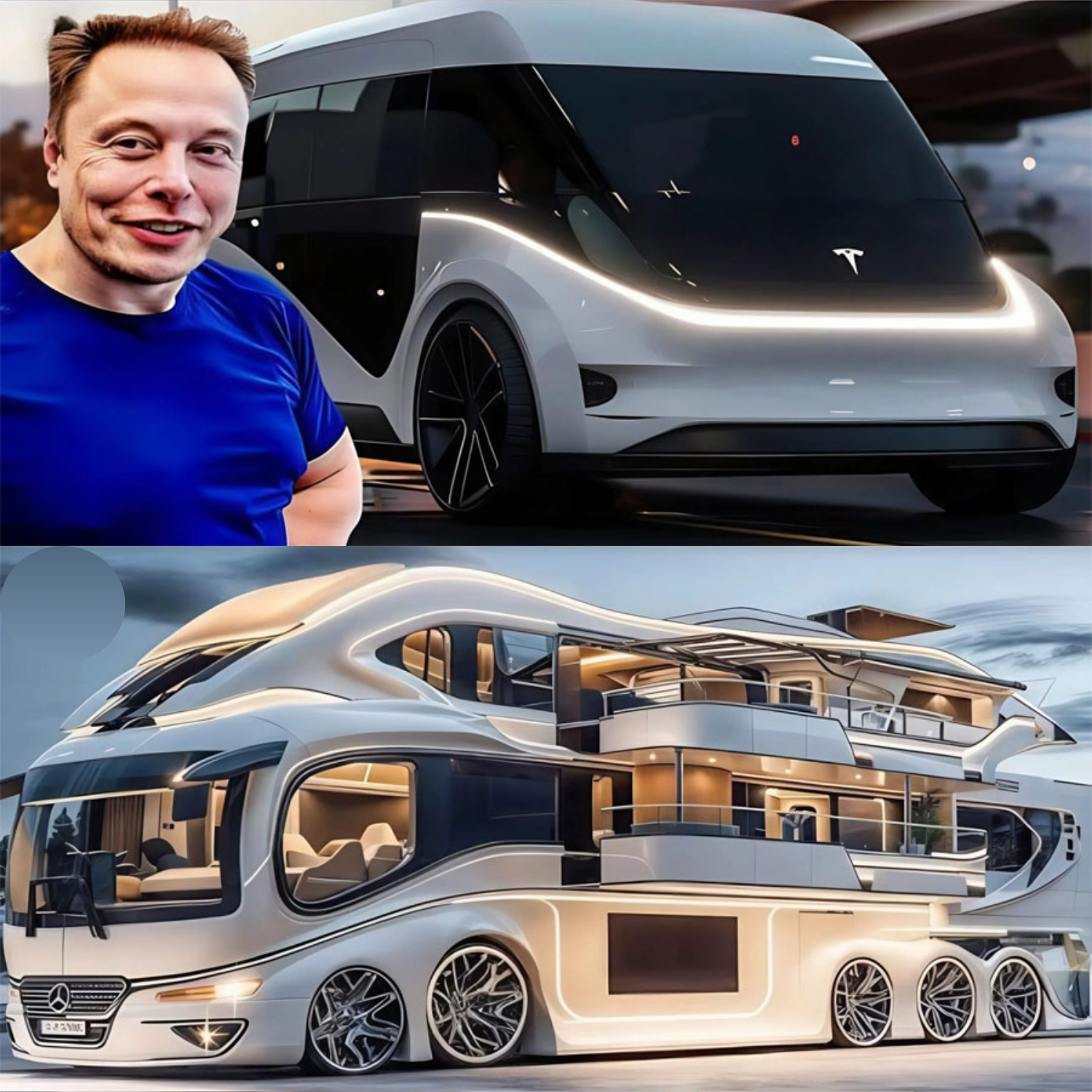


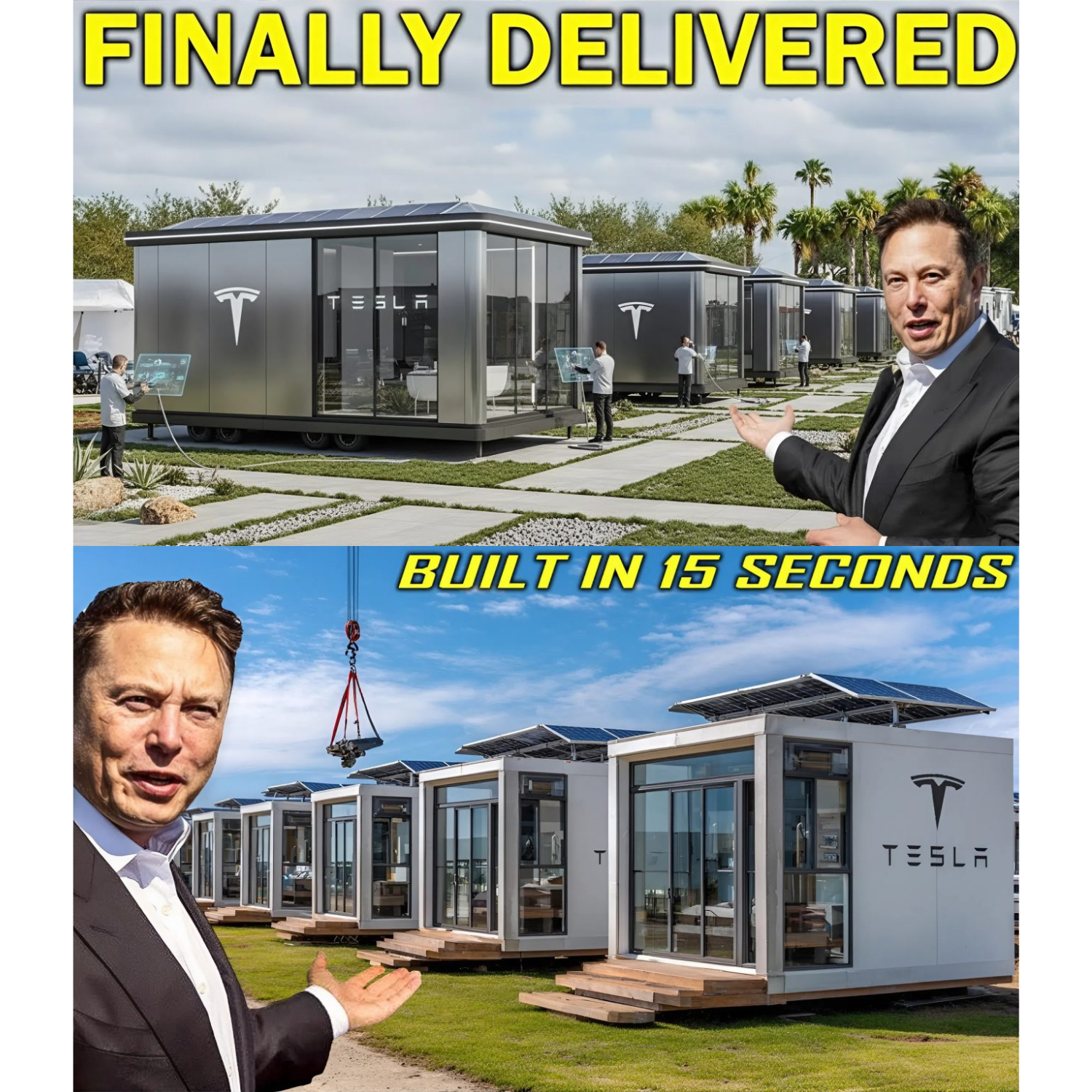
BREAKING: $7,999 TESLA TINY HOUSE — ELON MUSK’S FREE LAND DEAL STUNS THE WORLD! NEVER BEEN CHEAPER!
Elon Musk has done it again. Just when the world thought the Tesla Tiny House was too futuristic to be real, Musk unveiled the $7,999 Tesla Tiny House Freedom Plan, and it’s turning the global housing market upside down.
Fully solar-powered, AI-operated, and built for total off-grid living, this ultra-affordable home is being hailed as “the biggest housing disruption in a century.” But the part that has everyone talking isn’t the design, the tech, or even the price — it’s the free land deal that comes with it.
According to Musk, the offer represents “a freedom plan for everyone — to live anywhere, without rent, taxes, or bills.” Yet buried in the fine print of that promise is a hidden clause that no one saw coming — and it’s sending shockwaves through real estate, government, and finance circles alike.
THE REVEAL THAT BROKE THE INTERNET
The announcement came during a late-night Tesla Energy event in Austin, Texas. With no flashy build-up or celebrity cameos, Musk stepped on stage, holding a miniature version of the new Tesla Tiny House in his hand.
“This is more than a home,” he said. “It’s independence — solar-powered, Starlink-connected, and built to last longer than you do.”
The crowd erupted in applause. Within minutes, #TeslaTinyHouse, #FreedomPlan, and #EndOfRent were trending globally.
But as Musk continued, the presentation grew increasingly visionary — and controversial.
“You don’t need a mortgage, you don’t need permission, and you don’t need a power company,” he added. “Just sunlight, space, and a Tesla.”
THE HOUSE THAT POWERS ITSELF
The $7,999 Tesla Tiny House might be compact, but it’s packed with features that feel straight out of science fiction:
Tesla Solar Roof 2.0:
The entire roof is a solar array capable of generating enough energy for 3 full days of off-grid use, supported by a Tesla Powerwall Mini mounted discreetly inside.
Self-Sustaining Power System:
You’ll never pay another utility bill. The Powerwall Mini can recharge itself in 2 hours of direct sunlight — even on cloudy days, thanks to a new “Photonic Boost” algorithm that captures ambient light.
Starlink Global Internet:
Every unit comes with lifetime free Starlink internet, guaranteeing instant connectivity from virtually anywhere — desert, mountain, or island.
AI Smart Core:
Tesla’s built-in AI “Optimus Home” system learns your daily patterns, automatically adjusting light, temperature, and power consumption while offering real-time security monitoring and emergency alerts.
Portable, Expandable Design:
The home ships in a compact form factor and can unfold into a 430-square-foot living space in less than 90 minutes. One person can assemble it with Tesla’s new “AutoLock frame” — no heavy machinery required.
THE FREE LAND DEAL — AND THE CATCH
Here’s the part that stunned the world:
Every Tesla Tiny House buyer automatically qualifies for a “Freedom Plot” — small parcels of rural or renewable-zoned land across the U.S., pre-approved for permanent or semi-permanent placement.
It’s a never-before-seen housing incentive: a $7,999 home, with free land included.
But here’s where it gets mysterious. In the fine print of Tesla’s announcement, one clause raised eyebrows:
“Tesla reserves the right to relocate Freedom Plots as part of its national sustainability network.”
Translation? You might not actually “own” the land forever — it’s part of what Musk calls a “rotational living model”, where residents can choose to relocate every few years to new solar communities as Tesla expands.
Some see it as an ingenious step toward a dynamic, mobile civilization.
Others call it a modern nomadic experiment with corporate strings attached.
WHAT MUSK SAYS — AND WHAT IT MEANS

When pressed by reporters about the relocation clause, Musk didn’t deny it. He smiled and said:
“Freedom doesn’t mean staying in one place. It means having the choice to move wherever your heart — or your solar grid — takes you.”
To his supporters, it’s another visionary leap toward self-sustaining global communities.
To his critics, it’s Tesla’s attempt to privatize the concept of property itself.
One housing analyst put it bluntly:
“He’s not just selling homes — he’s reinventing citizenship.”
THE TECH INSIDE: A SMART HAVEN IN 430 SQ. FT.
Step inside, and the Tesla Tiny House feels like a fusion between a modern apartment and a spaceship cabin.
The living area features modular AI furniture that adjusts its layout throughout the day — beds fold into walls, desks rise from the floor, and windows tint automatically for energy efficiency.
A digital interface on the wall connects to Tesla’s global network, showing real-time solar stats, air quality, and even regional Starlink traffic.
And with Tesla Home Voice, residents can issue any command — from “Prepare for storm mode” to “Turn on movie night” — using simple speech or neural prompts through wearable sensors.
“It’s like living inside your Tesla, only quieter,” joked one beta tester.
REAL ESTATE PANIC AND POLICY QUESTIONS
The ripple effects have already started.
Realtors are calling it the “Musk Effect”, warning that traditional housing markets could nosedive as millions consider swapping mortgages for modular independence.
State housing departments are scrambling to understand how Tesla’s “Freedom Land” plots will fit into existing zoning laws. Since each location doubles as a solar hub, Tesla technically classifies them as energy infrastructure, not real estate — a loophole that could upend decades of property legislation.
Economist Rachel Klein warned,
“If this scales globally, governments may no longer control who lives where — Tesla will.”
BOXABL, RIVALS, AND THE INDUSTRY’S SHOCKED SILENCE
It didn’t take long for Musk’s former partner brand Boxabl to feel the tremors.
Within hours of the reveal, Boxabl’s stock fell 12%. Insiders admitted they had “no defense against a $7,999 Tesla-built home.”
Competitors from modular startups to RV giants have stayed quiet, perhaps hoping Musk’s bold promise of free land might fizzle. But the numbers say otherwise — Tesla reported over 3.2 million preorders in the first 48 hours.
Even Apple’s design chief was asked whether the company might enter “the smart housing race.” He simply laughed and said:
“You can’t outbuild Elon.”
A HOME FOR EVERY HUMAN — OR SOMETHING BIGGER?
What makes this launch more than a business move is the philosophy behind it.
For Musk, this is the logical next step after Tesla’s vehicles, batteries, and satellites — a home that completes the circle of human autonomy.
“If you control your power, your internet, and your shelter,” he said, “you control your destiny.”
Many believe the Tesla Tiny House is part of Musk’s wider vision for “Planetary Independence” — a network of sustainable housing models that could be replicated anywhere on Earth… or Mars.
THE WORLD REACTS: FROM PRAISE TO PANIC
Social media lit up instantly. Videos of the unveiling amassed over 200 million views in 24 hours, with supporters calling it “the dawn of true freedom.”
Others, though, raised concerns about privacy, land control, and AI integration.
“It’s amazing,” wrote one commenter, “but when your house is connected to the cloud — who owns your home, you or the code?”
Still, the public mood is overwhelmingly positive. For millions struggling with rent, inflation, and housing insecurity, the Tesla Tiny House feels less like a gadget and more like hope.
THE FINAL WORD: A REVOLUTION FOR $7,999
Whether you see it as liberation or disruption, there’s no denying the impact.
A fully self-sustaining home, powered by sunlight, connected by satellites, and priced lower than an iPhone — paired with land.
It’s the kind of bold, world-bending move only Elon Musk could pull off.
And as for that mysterious relocation clause? Musk left the stage with a grin, saying only:
“You’ll understand why it’s there… when the world runs on sunlight.”
For now, one thing’s certain: the Tesla Tiny House isn’t just redefining housing.
It’s redefining what it means to belong.
Elon Musk unveiled the Tesla Tiny House for just $7,789
Читать вTelegram
Elon Musk stated that this project will be a solution to the global housing accessibility problem
Entrepreneur Elon Musk showcased the Tiny House concept from Tesla, which costs only $7,789, according to media reports.
This house, covering an area of 76 square meters, promises complete autonomy, no tax obligations, and no need to purchase land.
Musk emphasizes that this project will help address the affordable housing issue and demonstrate how to integrate sustainable technologies, energy efficiency, and comfort.
The REAL deal: Of Elon Musk and Tesla tiny homes
By Au Foong Yee / The Edge Malaysia

This article first appeared in Forum, The Edge Malaysia Weekly on February 26, 2024 – March 3, 2024
Elon Musk is hot news. When rumours surfaced that he had unveiled a US$15,000 sustainable
Tesla home, of course, the news went viral. Netizens quickly dubbed it “the home of tomorrow”.
YouTube is swamped with videos providing exciting details and descriptions of these tiny homes. One video went so far as to quote the price at a mere US$10,000!
Going by the lavish online description of the “Tesla home”, it is a no-brainer buy by any standard. Just imagine owning a US$15,000 Tesla-branded and fully-furnished home. It is touted to be box-shaped and manufactured in a factory, to be transported to the desired location by truck and assembled within two days. The standard layout offers two bedrooms, a living room, a kitchen and a bathroom. There is no mention of size.
Meanwhile, the walls are supposedly made from sustainable eco-friendly materials that are fireproof, mould resistant and capable of withstanding hurricanes! On the roof are solar panels designed to not only power the house but from which excess energy can be retrieved and stored in a power wall. Rainwater would be collected and filtered for use, and the excess stored.
Besides being energy-efficient and environmentally friendly, these homes are also supposed to be connected to the Tesla Home app.
How cool is that! A dream tiny home that ticks all the boxes for future proofing and is available at an affordable price.
But before you rush to try to place an order for this incredible “Tesla home”, pause for a moment. I hate to burst your bubble, but Elon Musk has not actually revealed any Tesla tiny sustainable home.
Seriously, doesn’t getting a Tesla-branded home designed and equipped for future living at US$15,000 sound too good to be true?
So, how did the rumour about Tesla tiny homes come about?
In 2021, Musk tweeted about the US$50,000 home he had rented from SpaceX in Boca Chica, a Texas town known for its proximity to SpaceX’s Starbase launch site. That seemed to be Musk’s closest association with a tiny home. The tweet could have sparked the clickbait videos targeting Musk’s huge persona to push the sale of tiny homes.
Wikipedia calls the tiny-house movement an architectural and social movement promoting the reduction and simplification of living spaces. Tiny homes are trendy. They have been around for decades, yet their appeal remains strong. It cannot be said with certainty when and where the trend started but what is certain is that it is here to stay.
Tiny homes might have started as a fad; ownership a trendy novelty for those who live in sprawling homes. Over time, they have evolved into popular holiday homes to be rented out to tourists at the seaside or on hillslopes. The thought of having a custom-made tiny home on tow during road trips does sound rather inviting.
Overhaul designs of terraced homes
Tiny homes are already in our midst. Caravans, cabins or containers have been remodelled for housing or commercial activity purposes.
A modest 400 sq ft or so apartment is not uncommon as developers target first-time homeowners with affordable price tags. These units are usually furnished to showcase optimised spatial planning and liveability.
Terraced homes, meanwhile, remain a dream investment. The older terraced units are usually 24ft by 75ft or 80 t, with the rare bigger ones measuring 25ft wide or even 100ft long. This is usually owing to the shape of the land on which they are situated.
Naturally, the high demand for terraced units is fuelled by their scarcity. To make them more affordable, the only way is to either shrink the built-up or go upwards to three storeys, or both. Without doubt, tiny terraced homes are inevitable when one wants to focus on affordability. Some developers are already moving towards this strategy. Homes are getting narrower and shorter.
Small, however, does not necessarily mean inferior. What we need is an overhaul of the traditional terraced house concept, look, use of space and functionality. I would say that a revamp of the traditional design is overdue, given how creativity and changing lifestyles have evolved.
To start with, a smaller house immediately allows for the introduction of more natural lighting and airflow into the home and this augurs well for sustainability. There is no room for “dead” corners; all good to have but underutilised space must go. Less can be more.
It is timely to introduce future-proofing elements like solar power and proper rainwater harvesting systems. Let us also not forget the value of green space, albeit tiny, within the house. Bringing nature into the home will go a long way towards uplifting its liveability.
The possibilities of tiny homes are endless. If we can successfully build tiny apartments, why not small terraced homes?
Still, the ultimate question that begs to be answered is whether the market is ready for tiny terraced homes. It all boils down to changing the mindset. That is the real deal.