

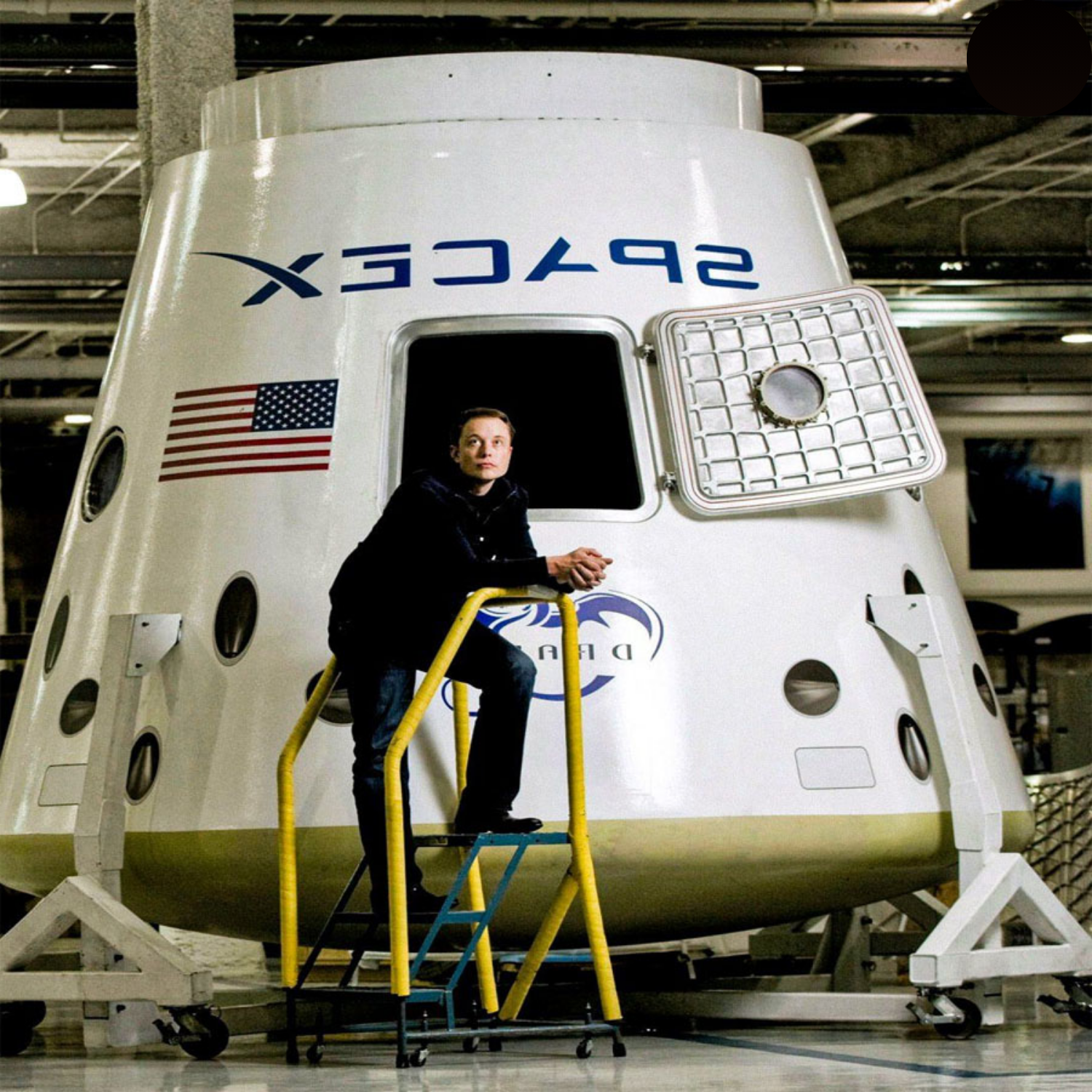
Elon Musk, the visionary entrepreneur whose name is synonymous with innovation, didn’t just aim for the stars—he built a company to conquer them. Founded in 2002, SpaceX (Space Exploration Technologies Corp.) has transformed from a risky startup on the brink of failure to a powerhouse revolutionizing space travel. As of August 2025, with over 500 successful Falcon launches and ambitious plans for Mars colonization, Musk’s journey with SpaceX is a testament to relentless ambition, groundbreaking engineering, and the audacity to challenge the impossible. This article chronicles the highs, lows, and pivotal moments that shaped SpaceX into the world’s leading private space company, highlighting Musk’s unyielding drive to make humanity multi-planetary.
The Spark: Musk’s Early Inspirations and Bold Vision
Elon Musk’s fascination with space began long before SpaceX. Born in Pretoria, South Africa, in 1971, Musk was an avid reader of science fiction, devouring works like Isaac Asimov’s Foundation series and Robert Heinlein’s novels. These stories fueled his belief that humanity’s survival depends on becoming a spacefaring civilization. After selling Zip2 for $307 million in 1999 and PayPal for $1.5 billion in 2002, Musk had the capital to pursue his dreams. Frustrated by NASA’s slow pace and the high costs of spaceflight—rockets were disposable and exorbitantly priced—Musk saw an opportunity. He invested $100 million of his own fortune to found SpaceX in May 2002, with the audacious goal of reducing space transportation costs by a factor of 10 and enabling Mars colonization.
Musk’s vision was clear from the start: “If we can make spaceflight affordable, we can open up space to humanity,” he stated in early interviews. Headquartered in Hawthorne, California, SpaceX began with a small team of engineers in a modest warehouse. Musk, drawing from his self-taught rocketry knowledge (he famously read textbooks like Rocket Propulsion Elements), set out to build reusable rockets—a concept dismissed by industry giants like Boeing and Lockheed Martin as impractical.
Early Struggles: Failures, Financial Peril, and Perseverance
The road to success was fraught with setbacks. SpaceX’s first rocket, Falcon 1, named after the Millennium Falcon from Star Wars, faced three consecutive failures between 2006 and 2008. The first launch in March 2006 ended in a fireball due to a fuel leak; the second in 2007 suffered engine shutdown; the third in 2008 exploded mid-flight, destroying payloads for NASA and the Department of Defense. These disasters nearly bankrupted the company, with Musk admitting in a 2017 TED Talk that he was “days away from personal bankruptcy” after pouring his remaining funds into the venture.
Amid the 2008 financial crisis, SpaceX teetered on the edge. Musk juggled crises at Tesla (another near-collapse) while securing a crucial $1.6 billion NASA contract for cargo deliveries to the International Space Station (ISS). On September 28, 2008, Falcon 1’s fourth launch succeeded, becoming the first privately developed liquid-fueled rocket to reach orbit. This breakthrough saved the company and validated Musk’s reusable rocket concept.
Breakthrough Milestones: From Falcon to Dragon and Beyond
With momentum building, SpaceX accelerated. In 2010, the Falcon 9 rocket debuted, a medium-lift vehicle capable of carrying heavier payloads. That December, SpaceX achieved another first: launching the Dragon capsule into orbit and recovering it intact—the first commercial spacecraft to do so. Dragon’s success led to NASA’s Commercial Resupply Services contract, with SpaceX delivering cargo to the ISS starting in 2012.
Reusability became SpaceX’s holy grail. In 2015, a Falcon 9 booster landed vertically for the first time after deploying satellites, slashing launch costs from $200 million to around $60 million per flight. This innovation disrupted the industry, forcing competitors to adapt. By 2018, the Block 5 Falcon 9 was refined for rapid reuse, and SpaceX began launching Starlink satellites to build a global internet constellation—now boasting over 6,000 satellites in orbit as of 2025.
Human spaceflight marked a pinnacle. In May 2020, Crew Dragon’s Demo-2 mission carried NASA astronauts Doug Hurley and Bob Behnken to the ISS, ending America’s reliance on Russian Soyuz rockets. By May 2025, SpaceX had completed 15 commercial crewed launches, 10 funded by NASA, solidifying its role in human space exploration.
Starship, Musk’s next-generation spacecraft, represents the ultimate ambition. Unveiled in 2018, this fully reusable system aims for Mars missions. Despite early explosions during test flights (notably the dramatic failures in 2020-2023), Starship achieved orbital insertion in March 2024. By mid-2025, multiple test flights have refined its Super Heavy booster, with Musk targeting uncrewed Mars landings in 2026 and crewed missions by 2028.
Overcoming Challenges: Regulatory Battles, Explosions, and Criticism
SpaceX’s journey wasn’t without controversy. Musk clashed with regulators over launch approvals and environmental concerns at Boca Chica, Texas. High-profile failures, like the Starship explosions, drew media scrutiny, but Musk embraced them as learning opportunities: “Failure is an option here. If things are not failing, you are not innovating enough.” Financially, SpaceX raised billions through investments, valuing the company at over $200 billion in 2025.
The COVID-19 pandemic tested operations, but SpaceX adapted, launching 132 Falcon missions in 2024—a record—and gearing up for even more in 2025. As of June 2025, Falcon 9 has flown 507 missions with a 99% success rate, including the 500th launch milestone deploying Starlink satellites.
Recent Achievements and the Road Ahead
In 2025, SpaceX continues to dominate. The company achieved its 500th Falcon launch in June, expanding Starlink to serve millions worldwide. Partnerships with NASA for the Artemis program position Starship as the lunar lander, with a test flight planned for late 2025. Musk’s vision extends to point-to-point Earth travel via Starship, potentially revolutionizing global transportation.
Challenges persist: competition from Blue Origin and regulatory hurdles for Starship’s rapid iterations. Yet, Musk’s leadership—marked by 18-hour workdays and bold tweets—drives progress. “The point of all this is to make life multi-planetary,” Musk reiterated in a 2025 X post.
Conclusion: A Legacy in the Stars
Elon Musk’s journey with SpaceX is more than a business story—it’s a saga of human ingenuity. From near-collapse in 2008 to over 500 launches and Mars-bound dreams, SpaceX has democratized space, inspiring a new generation. As Musk pushes boundaries, his company stands as proof that one person’s vision can propel humanity forward. With Starship on the horizon, the next chapter promises even greater leaps, ensuring SpaceX’s place in history as the architect of our interstellar future.
Elon Musk and SpaceX: A Case Study of Entrepreneuring as Emancipation
August 2019
Steven Muegge, Ewan Reid

Download this article as a PDF
We are at a turning point in the history of space exploration and development. … The established state-run industrial space sector is no longer the only game in town.
Gary Martin,
Director of Partnerships, NASA Ames Research
Abstract
Elon Musk and SpaceX are central to the profound change underway in the space industry, opening up the sector to entrepreneurship and innovation by non-traditional new entrants. We employ the emancipation perspective on entrepreneuring as a theoretical lens to describe, explain, and interpret the entrepreneuring activities of Musk to launch and grow SpaceX. Applying an event study approach combining case methods and process theory methods on publicly-available sources, we develop six examples of seeking autonomy, seven examples of authoring, and four examples of making declarations—the three core elements of the emancipation perspective. Our work contributes to the theory and practice of innovation by adding to the corpus of descriptive case studies that examine entrepreneuring as an emancipatory process.
Introduction
The article presents results from a case study of the entrepreneuring activities undertaken by Elon Musk between 2001 and 2015 to launch and grow Space Exploration Technologies Corporation (SpaceX, https://www.spacex.com/), a private commercial spaceflight venture. We employ the emancipation perspective on entrepreneuring (Rindova et al. 2009) as a theoretical lens to identify, describe, and interpret examples of seeking autonomy, authoring, and making declarations—the three core elements of entrepreneuring as emancipation. Our work contributes to the theory and practice of innovation by adding to the corpus of descriptive case studies that examine entrepreneuring as an emancipatory process.
First proposed by Rindova et al. (2009) in the Academy of Management Review, Jennings et al. (2016, p. 81) describes the emancipation perspective as “groundbreaking,” with “paradigm-shifting potential” for understanding entrepreneurship and innovation. Theory-building requires careful observation and accurate description (Christensen & Raynor, 2003) undertaken by engaged scholars (Van de Ven, 2007). Description and explanation are strengths of case study research designs (Yin, 2014; Eisenhardt et al. 2016). Thus, we argue that a corpus of well-designed and rigorously-executed case studies employing the emancipation perspective to examine high-impact technology innovations could accelerate theory-building about technology entrepreneurship and innovation. Nonetheless, there remains a dearth of published case research on these topics (Jennings et al. 2016; Reid, 2018). This paper is the second in a series of case study publications addressing this gap by examining the activities of NewSpace entrepreneurs (Zubrin, 2013; Pekkanen, 2016; Martin, 2017). Our previous paper examined Sir Richard Branson and Virgin Galactic (https://www.virgingalactic.com/) (Muegge & Reid, 2018); a forthcoming paper will examine Peter Diamandis and the XPRIZE Foundation (https://www.xprize.org/).
The article proceeds as follows. The first section reviews the relevant prior research on the emancipation perspective on entrepreneuring. The second section describes the research method. The third section introduces the case of Elon Musk and SpaceX. The fourth, fifth, and sixth sections each present results about one of the three core elements of entrepreneuring: seeking autonomy, authoring, and making declarations, respectively. The seventh section discusses the results, and the eighth section concludes.
Entrepreneuring as Emancipation
Entrepreneuring refers to “efforts to bring about new economic, social, institutional, and cultural environments through the actions of an individual or group of individuals” (Rindova et al. 2009, p. 477). Entrepreneuring is thus about the creation of something new, not merely about change.
Emancipation refers to “the act of setting free from the power of another” (Webster’s Revised Unabridged Dictionary, 1996). The focal point of inquiry is thus the “pursuit of freedom and autonomy relative to an existing status quo” (Rindova et al. 2009, p. 478).
The Rindova et al. (2009) emancipation perspective of entrepreneuring connects these two ideas, emphasizing verbs and actions rather than nouns and things. “We theorize that … three core elements are central to an emancipatory process” (p. 479):
- Seeking autonomy is the impetus for entrepreneuring—the perceived need of the entrepreneur to break free of or break up perceived constraints
- Authoring is defining new resource arrangements, relationships, and rules of engagement—taking ownership to change positions of power, to realize change-creating intent, and to preserve and enhance emancipatory potential
- Making declarations is about managing interpretations and expectations, mobilizing support, and generating change effects through discursive and rhetorical acts about intended change
The emancipation perspective emphasizes change creation: wealth creation may feature also, but it need not dominate the intended change. Rindova et al. (2009) write, “We believe that entrepreneurship research perhaps has become a bit too narrowly focused on wealth creation via new ventures” (p. 478) and “The implied opposition between emancipatory projects to create change and a ‘hard-nosed business strategy’ is a false one” (p. 483).
Method
Our research problem is identification and description of the NewSpace entrepreneuring activities undertaken by Musk using the framework and constructs of the emancipation perspective on entrepreneuring. Our field setting, the space industry, is in the midst of resurgence and profound change (Reid, 2018b, 2019; Davenport, 2018; Fernholz, 2018). Davenport (2016, p. 3) writes:
“Another space race is emerging, this time among a class of hugely wealthy entrepreneurs who have grown frustrated that space travel is in many ways still as difficult, and as expensive, as ever. Driven by ego, outsized ambition and opportunity, they are investing hundreds of millions of dollars of their own money in an attempt to open up space to the masses and push human space travel far past where governments have gone.”
Martin (2017), Director of Partnerships for the NASA Ames Research Center, writes: “The established state-run industrial space sector is no longer the only game in town” (p. 3).
Our research design is an event study (Van de Ven, 2007), combining case methods (Yin, 2014; Eisenhardt et al. 2016) with process theory methods (Poole et al. 2000) to operationalize the core constructs of the emancipation perspective. We focus on a single entrepreneur and their venture using publicly-available data sources. Our source for identifying events was a book-length biography, Elon Musk: Tesla, SpaceX, and the Quest for a Fantastic Future (Vance, 2015). Musk cooperated in the production of the book by providing interviews, documents, and access to other people, but did not review the book prior to publication or exert editorial control.
We employed NVivo qualitative data analysis (QDA) software, a set of coding rules, and a common framework for specifying events. Our analysis began with incident coding of the main source to identify and tag relevant passages of text, followed by event coding of the incidents to identify and specify a set of emancipation events. We then enfolded additional evidence, context, and perspectives from other sources, including published interviews with Musk, press releases from the SpaceX website, and articles about Musk and SpaceX. Each event record in the QDA software preserved links to evidence in the source material.
Our use of publicly-available sources (rather than primary interviews) is similar to the approach of Rindova et al. (2009) in the seminal article about emancipation. First-hand accounts by the focal entrepreneur are triangulated with stories from others and with other publicly-available records.
Our outcome is a set of case results, presented in a narrative form, structured using the constructs of the emancipation perspective. We report seventeen emancipation events:
- Six seeking autonomy events as the impetus for entrepreneurship, describing Musk’s perceived need to break free of or break up a perceived constraint
- Seven authoring events of Musk taking ownership by defining relationships, arrangements, and rules of engagement, and changing the positions of power
- Four making declarations events of Musk’s discursive and rhetorical acts about change-creating intent
Elon Musk and Space Exploration Technologies Corporation (SpaceX)
According to the company website: “SpaceX designs, manufactures and launches advanced rockets and spacecraft. The company was founded in 2002 to revolutionize space technology, with the ultimate goal of enabling people to live on other planets.”
Elon Musk was born in South Africa in 1971, moved to Canada in 1989 to attend Queen’s University (Kingston, Ontario), then transferred to the University of Pennsylvania in 1991. After completing degrees in economics and physics, he moved to to Silicon Valley in 1995, where he launched and exited two technology startups. Vance (2015, p. 14) summarizes this period prior to SpaceX, as follows:
“Fresh out of college, he founded a company called Zip2—a primitive Google Maps meets Yelp. That first venture ended up a big, quick hit. Compaq bought Zip2 in 1999 for $307 million. Musk made $22 million from the deal and poured almost all of it into his next venture, a startup that would morph into PayPal. As the largest shareholder in PayPal, Musk became fantastically well-to-do when eBay acquired the company for $1.5 billion in 2002.”
Musk moved to Los Angeles in 2001: “While Musk didn’t know exactly what he wanted to do in space, he realized that just by being in Los Angeles he would be surrounded by the world’s top aeronautics thinkers. They could help him refine any ideas, and there would be plenty of recruits to join his next venture” (p. 99). One of those people was Robert Zubrin, an aerospace engineer, advocate of human exploration of Mars, and co-founder of The Mars Society (https://www.marssociety.org). Like Musk, Zubrin was frustrated by the priorities and slow progress at NASA, saying, “America’s human spaceflight program is now adrift” (Zubin, 2013, p. 24); “There is, however, a bright spot on the horizon in the form of a wave of entrepreneurial activity, most particularly that of the SpaceX company” (p. 54). Zubrin (2013, p. 56) describes his impressions of Musk:
“Unlike the other would-be space magnates, Musk did not simply throw an expendable chunk of his fortune into the game; he put the full force of his talent and passion into it. When I met Musk in 2001, he had a good grasp of scientific principles, but knew nothing about rocket engines. When I visited him at his first small factory in Los Angeles in 2005, he knew everything about rocket engines. By the time of my next visit a few years later, he had experienced two straight failures of his first launch vehicle, the Falcon 1, but was determined to push on despite the blows to his finances and reputation. It is this level of commitment that has made all the difference. None of the other billionaire-backed space startups have ever cleared the tower. SpaceX has delivered Cargo to the space station and will soon be sending people.”
By all close accounts (for example, Zubrin, 2013; Diamandis & Kotler, 2015; Vance, 2017), Musk’s ultimate ambition, even before founding SpaceX in 2002, was sustainable human settlement on Mars, thus making humans a multi-planetary species (Musk, 2017).
Table 1 reports a timeline of Musk’s early entrepreneurial activities, significant milestones for SpaceX, and stated future goals. Our emphasis here is exclusively SpaceX. Musk’s other business and not-for-profit ventures subsequent to founding SpaceX, including Tesla (2003), SolarCity (2006), Hyperloop (2012), OpenAI (2015), Neuralink (2016), and The Boring Company (2016), are out of scope of our research problem and thus excluded from the table.