


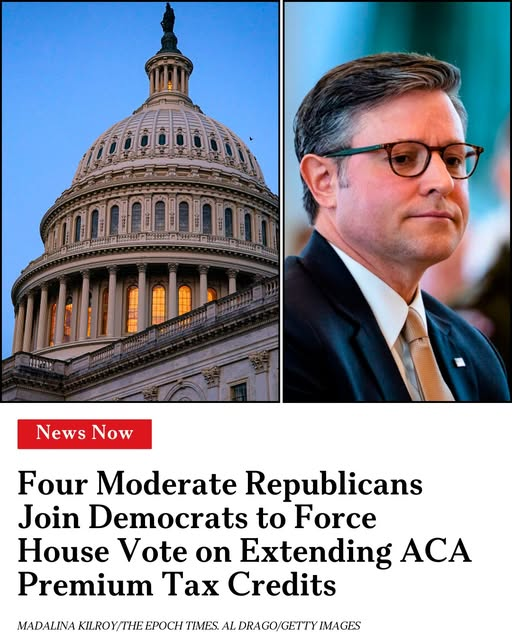
On December 17, 2025, four moderate House Republicans—Reps. Brian Fitzpatrick (PA), Mike Lawler (NY), Rob Bresnahan (PA), and Ryan Mackenzie (PA)—signed a discharge petition led by House Minority Leader Hakeem Jeffries (D-NY), providing the 218 signatures needed to force a floor vote on a bill extending enhanced Affordable Care Act (ACA) premium tax credits for three years.
The credits, expanded under prior administrations and set to expire December 31, 2025, help lower premiums for approximately 22 million Americans enrolled in ACA marketplace plans. Without extension, premiums are projected to rise significantly.
The move came after weeks of unsuccessful negotiations within the GOP for a compromise extension, including rejected amendments to a separate Republican health care bill advanced by leadership. Moderates argued that inaction would lead to premium increases harming constituents. “There should be an extension of the ACA tax credits for some period of time,” said Rep. Ryan Mackenzie, one of the signers.
Some Republicans criticized the action as undermining party unity. “They’re stabbing the rest of the party in the back,” said Rep. Eric Burlison (R-MO). The discharge petition ensures a vote in early January 2026, though the bill’s prospects in the Senate remain uncertain, and subsidies are expected to lapse in the interim.
Speaker Mike Johnson (R-LA) has opposed a clean extension, favoring alternative health care reforms instead.
Meet the 4 Republicans who defied House Speaker Mike Johnson on ACA subsidies
Four moderate House Republicans have broken ranks with Speaker Mike Johnson by supporting a Democratic petition to extend health care subsidies set to expire at the end of the year
ByMEG KINNARD Associated Press
December 18, 2025, 2:10 AM

1:06
Headlines from ABC News Live
0:08
1:06
Headlines from ABC News LiveCatch up on the developing stories making headlines.
The Associated Press
Four moderate House Republicans — from swing districts Democrats are already eyeing for next year’s midterms — have broken ranks with Speaker Mike Johnson, signing on to Democrats’ petition to force a vote on extending health care subsidies that expire at the end of this year.
From battleground districts in Pennsylvania and New York, the members on Wednesday sided against their party on the Democratic-led measure to force a vote on subsidy extensions related to Affordable Care Act — a move that came after House Republican leaders pushed ahead with a GOP health care bill that does not address impending soaring monthly premiums.
Acknowledging “these are not normal times,” Johnson said his party’s razor-thin majority allows a small number of GOP members to have an outsize influence in some of the chamber’s mechanics.
Meet the four Republicans bucking their party’s leadership over health care:
Fitzpatrick, who has been part of several bipartisan pushes this year, represents a perennial swing district in the presidential battleground state. Amassing bipartisan signatures for his own discharge petition related to ACA subsidy extension, earlier this year he was part of a coalition that spanned the political spectrum to rally support for a bill that would prohibit members of Congress and their families from owning and trading individual stocks.
“It’s not every day you see this cast of characters up here,” Fitzpatrick said. “You’re all smirking out there. That’s a good thing. It speaks to the power of this cause.”
Mackenzie drew an opponent barely 48 hours after voting for the House budget bill earlier this year.
Part of a bipartisan group pressing for an eleventh-hour compromise over the ACA subsidies, Mackenzie told The Associated Press earlier this month that lawmakers needed to understand that, “even if you have a broken system, that doesn’t mean that you shouldn’t provide or offer relief to individuals who are dealing with those high costs right now.”
Bresnahan and Mackenzie, both freshmen, won in November by some of the smallest margins in all of Congress. Already a top target for Democrats in next year’s midterms, Bresnahan and his district have already had high-level political attention.
Last week, President Donald Trump was in his district for an official White House event that seemed more like one of his signature campaign rallies that officials said he would hold regularly ahead of next year’s midterms.
Lawler’s district has been considered a crucial swing seat in recent elections, and Democrats are expected to again dedicate heavy resources to flip it next year. A moderate who last year won a second term, he openly expressed interest in running for governor but backed off those plans, saying he wanted to defend his battleground district.
Earlier this year, while many House Republicans shunned holding town halls in their districts as the Trump administration’s aggressive actions roiled constituents, Lawler instead sought to put himself in front of voters, who peppered him with questions and devolved into a chaotic chorus of boos.