


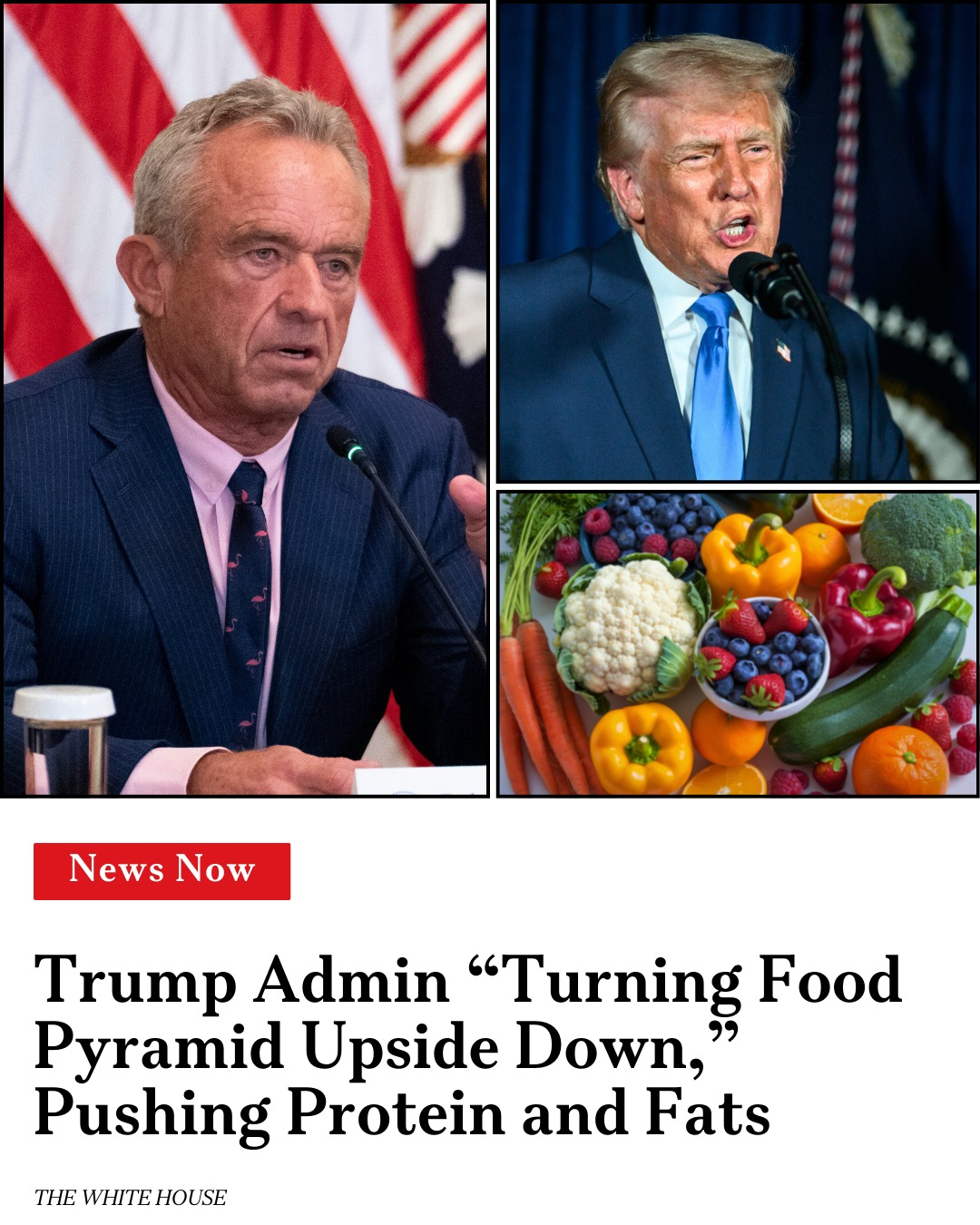
Trump admin ‘turning food pyramid upside down’ — pushing protein, fats
White House releases new Dietary Guidelines for Americans, ‘turning the food pyramid upside down’
WASHINGTON — The Trump administration is “turning the food pyramid upside down” with new guidelines for feeding programs that will emphasize eating plenty of protein and saturated fats — while discouraging the consumption of sugar and highly processed foods.
The White House released the revised Dietary Guidelines for Americans as part of a news conference Wednesday with Health and Human Services Secretary Robert F. Kennedy Jr. and Agriculture Secretary Brooke Rollins touting potential benefits in reducing chronic diseases for all Americans.
“We are ending the war on saturated fats,” Kennedy said — referring to products that are generally solid at room temperature like cheese, butter and fat in meats, which now are recommended to form the bulk of diets alongside meat and produce like carrots and broccoli.

The recommendations will directly impact millions of daily meals served in America’s public schools, military bases, prisons and various federal facilities.
“Today our government declares war on added sugar. Highly processed food loaded with additives — added sugar and excess salt — damage health and should be avoided,” Kennedy declared at the briefing.
“Diets rich in vegetables and fruits reduce disease risk more effectively than many drugs. Whole grains outperform refined carbohydrates,” he added.
Explore More

Renee Nicole Good was Minneapolis ‘ICE Watch warrior’ who trained to resist feds before shooting

Here’s who’s really behind the Minneapolis ICE resistance movement

Renee Nicole Good’s sobbing wife who claimed Minneapolis ICE shooting was ‘my fault’ revealed
“These guidelines replace corporate-driven assumptions [and] will revolutionize our nation’s food culture and make America healthy again.”
Kennedy, a former Democrat who endorsed Trump in 2024 and followed him into office with a “Make America Healthy Again” mantra, said prior food guidelines were the result of corporate influence, without specifying which firms allegedly benefited.
“The hard truth is our government has been lying to us to protect corporate profit-taking, telling us that these food-like substances were beneficial to public health,” Kennedy said.


“Today the lies stop. The new guidelines recognize that whole, nutrient-dense food is the most effective path to better health and lower healthcare costs. Protein and healthy fats are essential and were wrongfully discouraged in prior dietary guidelines.”
High-quality proteins like poultry, red meat and beans; fats from eggs or dairy; fruits, vegetable and “fiber-rich” whole grains are in — and starchy carbs such as white bread, crackers, or “sugar-sweetened” beverages as well as pre-packaged and ready-to-eat treats like chips, cookies and fast food are out.
A major goal of the so-called “whole food framework” will be “reducing health care costs,” as the US has seen surging rates of obesity, type 2 diabetes and other chronic diseases that are costing taxpayers roughly $600 billion per year, according to a White House fact sheet.
Start your day with all you need to know
Morning Report delivers the latest news, videos, photos and more.Enter your email address
By clicking above you agree to the Terms of Use and Privacy Policy.
At least 78% of Supplemental Nutrition Assistance Program participants are also on Medicaid, per the fact sheet, and administration officials expect the nation’s chronic disease rate could be “dramatically” lowered if different incentives are made.
Officials said the shift won’t directly alter SNAP, which is overseen by Congress and feeds more than 40 million Americans, but will become the gold standard for “over 100 government feeding programs in over 10 government agencies.”
“We have five times higher obesity rates than any other country in the developed world,” one official said. “This is because of our diet.”
Kennedy’s MAHA movement gained traction during his 2024 bid for the presidency — and he’s since extolled the benefits of protein-rich diets while in office.
In a March 2025 visit to West Virginia, the health secretary gave a few diet tips and even offered to be the personal trainer of Gov. Patrick Morrisey.


“The first time I saw him, I said, ‘You look like you ate Governor Morrisey,’” RFK said in a joint appearance with the governor of America’s fattest state. “I am going to put him on a really rigorous regimen, and we’re gonna put him on a carnivore diet.”
Dr. Bobby Mukkamala, president of the American Medical Association, celebrated the move in a statement noting the organization is “focused on helping physicians translate this science into everyday care and helping patients improve their overall health.
“The American Medical Association applauds the Administration’s new Dietary Guidelines for spotlighting the highly processed foods, sugar-sweetened beverages, and excess sodium that fuel heart disease, diabetes, obesity, and other chronic illnesses,” Mukkamala continued. “The Guidelines affirm that food is medicine and offer clear direction patients and physicians can use to improve health.”

The AMA will also “work with Congress to enact meaningful, lasting nutrition change that can improve lives,” its president noted, and provide additional educational resources for medical students and doctors as well as host roundtables to “make it easier for physicians to talk to patients about the role of food in preventing, and even treating, chronic disease.”
The Department of Agriculture previously switched from the food pyramid to MyPlate with then-first lady Michelle Obama and then-Agriculture Secretary Tom Vilsack in 2011, which began de-emphasizing the foundation of carbohydrates in a balanced diet.
The Trump White House’s fact sheet faulted the Biden administration for backtracking on addressing chronic diseases and improving Americans’ diets by making equity the “central prism” of all nutritional guidelines.
“We reject this logic: a common-sense, science-driven document is essential to begin a conversation about how our culture and food procurement programs must change to enable Americans to access affordable, healthy, real food,” the sheet stated.
“The Trump administration welcomes all stakeholders to be part of this conversation in the coming year.”
Trump admin ‘turning food pyramid upside down’ — pushing protein, fats
Josh Christenson, Steven Nelson
Wed, January 7, 2026 at 10:59 PM GMT+7
0

WASHINGTON — The Trump administration is “turning the food pyramid upside down” with new guidelines for feeding programs that will emphasize eating plenty of protein and saturated fats — while discouraging the consumption of sugar and highly processed foods.
The White House released the revised Dietary Guidelines for Americans as part of a news conference Wednesday with Health and Human Services Secretary Robert F. Kennedy Jr. and Agriculture Secretary Brooke Rollins touting potential benefits in reducing chronic diseases for all Americans.
“We are ending the war on saturated fats,” Kennedy said — referring to products that are generally solid at room temperature like cheese, butter and fat in meats, which now are recommended to form the bulk of diets alongside meat and produce like carrots and broccoli.

The recommendations will directly impact millions of daily meals served in America’s public schools, military bases, prisons and various federal facilities.
“Today our government declares war on added sugar. Highly processed food loaded with additives — added sugar and excess salt — damage health and should be avoided,” Kennedy declared at the briefing.
“Diets rich in vegetables and fruits reduce disease risk more effectively than many drugs. Whole grains outperform refined carbohydrates,” he added.
“These guidelines replace corporate-driven assumptions [and] will revolutionize our nation’s food culture and make America healthy again.”
Kennedy, a former Democrat who endorsed Trump in 2024 and followed him into office with a “Make America Healthy Again” mantra, said prior food guidelines were the result of corporate influence, without specifying which firms allegedly benefited.
“The hard truth is our government has been lying to us to protect corporate profit-taking, telling us that these food-like substances were beneficial to public health,” Kennedy said.


“Today the lies stop. The new guidelines recognize that whole, nutrient-dense food is the most effective path to better health and lower healthcare costs. Protein and healthy fats are essential and were wrongfully discouraged in prior dietary guidelines.”
High-quality proteins like poultry, red meat and beans; fats from eggs or dairy; fruits, vegetable and “fiber-rich” whole grains are in — and starchy carbs such as white bread, crackers, or “sugar-sweetened” beverages as well as pre-packaged and ready-to-eat treats like chips, cookies and fast food are out.
A major goal of the so-called “whole food framework” will be “reducing health care costs,” as the US has seen surging rates of obesity, type 2 diabetes and other chronic diseases that are costing taxpayers roughly $600 billion per year, according to a White House fact sheet.
Advertisement
At least 78% of Supplemental Nutrition Assistance Program participants are also on Medicaid, per the fact sheet, and administration officials expect the nation’s chronic disease rate could be “dramatically” lowered if different incentives are made.
Officials said the shift won’t directly alter SNAP, which is overseen by Congress and feeds more than 40 million Americans, but will become the gold standard for “over 100 government feeding programs in over 10 government agencies.”
“We have five times higher obesity rates than any other country in the developed world,” one official said. “This is because of our diet.”
Kennedy’s MAHA movement gained traction during his 2024 bid for the presidency — and he’s since extolled the benefits of protein-rich diets while in office.
In a March 2025 visit to West Virginia, the health secretary gave a few diet tips and even offered to be the personal trainer of Gov. Patrick Morrisey.


“The first time I saw him, I said, ‘You look like you ate Governor Morrisey,’” RFK said in a joint appearance with the governor of America’s fattest state. “I am going to put him on a really rigorous regimen, and we’re gonna put him on a carnivore diet.”
Dr. Bobby Mukkamala, president of the American Medical Association, celebrated the move in a statement noting the organization is “focused on helping physicians translate this science into everyday care and helping patients improve their overall health.
“The American Medical Association applauds the Administration’s new Dietary Guidelines for spotlighting the highly processed foods, sugar-sweetened beverages, and excess sodium that fuel heart disease, diabetes, obesity, and other chronic illnesses,” Mukkamala continued. “The Guidelines affirm that food is medicine and offer clear direction patients and physicians can use to improve health.”

The AMA will also “work with Congress to enact meaningful, lasting nutrition change that can improve lives,” its president noted, and provide additional educational resources for medical students and doctors as well as host roundtables to “make it easier for physicians to talk to patients about the role of food in preventing, and even treating, chronic disease.”
The Department of Agriculture previously switched from the food pyramid to MyPlate with then-first lady Michelle Obama and then-Agriculture Secretary Tom Vilsack in 2011, which began de-emphasizing the foundation of carbohydrates in a balanced diet.
The Trump White House’s fact sheet faulted the Biden administration for backtracking on addressing chronic diseases and improving Americans’ diets by making equity the “central prism” of all nutritional guidelines.
“We reject this logic: a common-sense, science-driven document is essential to begin a conversation about how our culture and food procurement programs must change to enable Americans to access affordable, healthy, real food,” the sheet stated.
“The Trump administration welcomes all stakeholders to be part of this conversation in the coming year.”
Laura Ingraham Admits Michelle Obama Was Right: ‘We Take It All Back’
Marco Margaritoff
Updated Thu, January 8, 2026 at 11:44 PM GMT+7
0
Fox News host Laura Ingraham on Wednesday championed the new food pyramid unveiled by Health and Human Services Secretary Robert F. Kennedy Jr., but after spotting its central financial hurdle for working-class Americans, had to admit that Michelle Obama was “right.”
Kennedy announced earlier in the day alongside Agriculture Secretary Brooke Rollins that the inverted new food pyramid prioritizes protein such as red meat, fish and poultry, as well as fruit, vegetables and healthy fats, over whole grains such as bread and cereal.
Politics: ‘A Reverse Funnel System’: RFK Jr. And Friends Roasted Over New, Flipped Food Pyramid
The “Ingraham Angle” host called it “a major MAHA win,” but quickly identified a problem.
Ingraham was discussing the guidelines on her show with Rollins and Kennedy, who is leading the “Make America Healthy Again” effort under President Donald Trump, when her remark that we should simply “encourage” children to eat healthily prompted a confession.
Rollins said, “A big pushback, that’s exactly right Laura, is people will say, ‘Oh, here comes the Trump administration, nanny state, it’s gonna be too expensive’ and ‘What happened to affordability?’ To eat healthy, to have fish or chicken or pork or beef with a side of vegetables, whole grain piece of bread, a glass of whole milk, is right around $3 to $4.”
She continued, “That’s less than any fast food meal that you could get. But what we have to do better at, and what we’re working on also, is those underserved communities that don’t have access to Whole Foods or [Texas-based supermarket chain] H-E-B—”
Politics: Karoline Leavitt’s Briefing Outfit Looks Strikingly Familiar, Critics Mock
That’s when Ingraham interrupted, “Michelle Obama used to call them ‘food deserts.’”
Advertisement
The former first lady had famously made the lack of healthy and affordable food for children a core issue of her “Let’s Move!” campaign while her husband Barack Obama was in office, only for Ingraham to urge Republicans in 2010 to be “vociferously opposed” to it.
“I used to kind of poke fun of her for that,” Ingraham said Wednesday. “Maybe is she right?”
“Well, yeah, in fact there’s part of that that’s correct,” Rollins said.
Ingraham, who slammed Michelle Obama in 2011 by stating one of her daughters “apparently is not living in a food desert,” followed suit.
Politics: Republicans Get A Taste Of How Wrong They Were About Michelle Obama’s Plan
“OK, so we take it all back,” the right-wing host admitted. “She’s right.”
Critics on social media have long spotted the conservative hypocrisy in championing Kennedy’s bid to “Make America Healthy Again” after openly condemning Obama, who even released a “food desert locator” in 2011 to help affected communities.
The outrage was so widespread among conservatives at the time that CNN released a montage last year of numerous Fox News hosts decrying Obama, including Glenn Beck and Sean Hannity telling her to get her “**** hands” off their French fries.
Related…
- Megyn Kelly Savagely Takes Down Fox News For Sucking Up To Trump
- Critics Erupt At Fawning CBS Evening News Segment On Marco Rubio: ‘Are You ******* Kidding Me?’
- Kristi Noem Taunts Newsom After Trump Announces Fraud Probe: ‘We’re Gonna Come To You’
Show comments
0
Advertisement
RFK Jr.’s diet guidelines emphasize red meat, full-fat dairy. How healthy are they?
MARY KEKATOS and LIZ NEPORENT
Fri, January 9, 2026 at 4:47 AM GMT+7
0

Scroll back up to restore default view.
Health and Human Services Secretary Robert F. Kennedy Jr. announced updated federal dietary guidelines on Tuesday, though some of the recommendations are being challenged by health experts.
The Dietary Guidelines for Americans, which are updated every five years, recommended that Americans limit highly processed foods and refined carbohydrates.
Some nutrition and diet experts, however, questioned other recommendations, including consuming red meat and full-fat dairy, a reversal of past nutrition guidance.
They told ABC News that while red meat and full-fat dairy can be part of a heathy diet, they also can be high in sodium and saturated fats, which can raise the risk of cardiovascular disease.
Emphasis on red meat and protein
In a factsheet released along with the guidelines, the administration said it was recommending that American prioritize eating protein-rich foods with every meal including red meat, poultry, seafood and eggs in addition to plant-sourced protein foods.
This is a stark contrast from past years in which guidelines have encouraged Americans to limit the amount of red meat being consumed.

Nutrition experts contend that red meat is high in protein and contains several nutrients including iron, zinc, potassium, vitamin B6 and vitamin B12.
However, some experts add that red meat is also high in saturated fats, which has been shown to increase levels of “bad” cholesterol and increase the risk of heart disease, according to the American Heart Association.
Additionally, the 2025 Scientific Report — an independent report written by the Dietary Guidelines Advisory Committee that helps the HHS and Department of Agriculture develop the next set of dietary guidelines — found that reducing items with saturated fats, such as processed and unprocessed red meat with plant-based protein foods, can lower cardiovascular disease risk.
“I’m concerned about the focus on protein and if we’re telling people to have protein at every meal that might increase overall meat consumption, and for many Americans that could also increase saturated fat intake, especially if people lean toward red meat rather than lean cuts of meat, seafood beans, nuts, and seeds as their protein sources,” Maya Feller, a registered dietitian based in New York City, told ABC News.
The factsheet also claimed that previous federal dietary guidelines have “demonized” protein in favor of carbohydrates.
RFK Jr. wants to expand the role of dairy in dietary guidelines. Here’s what the science says
“Protein was never demonized in U.S. dietary guidelines. As it is, Americans are consuming protein in amounts well above the amount that is necessary to sustain health and development,” Marie-Pierre St-Onge, a professor of nutritional medicine at Columbia University Vagelos College of Physicians and Surgeons, told ABC News.
The guidelines also advise adults to consume between 1.2 to 1.6 grams of protein per kilogram of body weight per day.
Feller said there isn’t enough evidence to suggest that all Americans need to be consuming that much protein, and that a variety of protein sources is beneficial.
“The majority of the population has one or more non-communicable diseases, which require thoughtful meal planning to adjust macronutrient needs,” she said. “Increasing protein intake should include a variety of proteins from both plant and animal sources.”
The American Heart Association said in a statement on Wednesday that it welcomes the new dietary guidelines and its emphasis on fruits and vegetables while limiting highly processed foods and added sugars.
However, regarding protein, the AHA said it encourages prioritizing plant-based proteins, seafood and lean meats and to limit high-fat animal products including “red meat, butter, lard and tallow, which are linked to increased cardiovascular risk.”
Mixed views on full-fat dairy
U.S. health officials said during a press conference on Wednesday that full-fat dairy products have been unfairly targeted.
Advertisement
“In this new guidance, we are telling young people, kids, schools, you don’t need to tiptoe around fat and dairy,” said Dr. Marty Makary, commissioner of the Food and Drug Administration. “You don’t need to push low-fat milk to kids.”

Dairy contains many nutrients, including calcium, magnesium, potassium, protein and vitamins A and D, according to the U.S. Department of Agriculture. These nutrients help build healthy bones and teeth as well as support immune health.
There is some contention around how much of a risk saturated fat is when it comes to dairy products for all ages. The previous dietary guidelines recommended Americans of all ages consume lower fat or fat-free dairy products when possible.
Feller said the guidance to consume full-fat dairy, such as whole milk, is generally not what she and others in her field recommend.
“I would say that a whole milk recommendation is not ideal for the whole population,” she said. “We generally recommend whole milk for people between the ages of one and three and then switching to a reduced fat milk.”
She added that if she knows someone has cardiovascular disease, or another medical condition she does not recommend full-fat milk.
Although full-fat dairy does contain higher amounts of saturated fat, some research has found that consuming full-fat milk, yogurt and cheese does not have different effects on risk factors of cardiovascular disease compared to low-fat dairy.
What are ultra-processed foods and how do they impact our health?
“The move to allow or recommend full-fat dairy marks a clear break from older guidance that was based more on assumptions about saturated fat than on direct evidence,” Dr. Max Peterson, an assistant professor in medicine in the division of endocrinology, metabolism and lipid research, Washington University School of Medicine in St. Louis, told ABC News.
“While the change may be controversial, current research does not clearly show that full-fat dairy increases cardiovascular risk, and it may be beneficial for certain populations, including children,” he added.
Critics wary of industry influence
Some experts and groups expressed concern that the updated guidelines emphasizing red meat and full-fat dairy may be influenced by industry ties.
A report from HHS discussed the scientific foundation of the guidelines indicates that external experts who were consulted are associated with groups including the National Cattlemen’s Beef Association (NCBA) and the National Dairy Council (NDC).
In a statement to ABC News, Katie Brown, president of the NDC, said “the latest guidance reflects decades of research showing that nutrient-rich dairy foods — milk, cheese and yogurt — at all fat levels fit in healthy eating patterns.”
She also said that the NDC does not attempt to influence policy.

The NCBA released a statement on Wednesday celebrating the updated guidelines, including “prioritizing protein at every meal like nutrient-dense beef. Red meat is specifically mentioned as a healthy source of protein in a varied, balanced diet.”
NCBA did not immediately reply to ABC News’ request for comment.
The nonprofit organization Physicians Committee for Responsible Medicine filed a complaint with HHS and USDA, urging the agencies to withdraw the guidelines over claims of industry influence.
The group released a statement, praising the recommendations to emphasize fruits and vegetables but calling on health officials to suggest limiting foods with saturated fats such as animal protein or full-fat dairy.
“The Dietary Guidelines were based on rigorous scientific review and independent oversight,” an HHS spokesperson told ABC News in a statement. “It is absurd to suggest that anything other than gold standard science guided our work on this presidential priority.”
ABC News’ Dr. Radhika Malhotra contributed to this report.