

BREAKING: ELON MUSK ANNOUNCES $789 TESLA PI PHONE LAUNCH — THE AI-POWERED BEAST THAT DESTROYS THE IPHONE 17!
With brain-link integration, solar charging, and Starlink connectivity, Musk’s new device is being hailed as “the smartest phone ever built.” Apple fans are in shock — and the internet is on fire.
A GLOBAL SHOCKWAVE IN TECH
At 9:47 p.m. Pacific time, Elon Musk walked onto the stage of Tesla’s Palo Alto headquarters wearing his trademark black jacket and a grin that told the world he was about to drop something explosive.
Behind him, the lights dimmed. A single glowing silhouette appeared on the giant screen — sleek, curved, and metallic red. The crowd erupted before he even spoke.
“It’s not just a phone,” Musk said. “It’s an extension of your mind.”
And just like that, the Tesla Pi Phone was officially born — a $789 device that promises to rewrite every rule of mobile technology, leaving Apple, Samsung, and Google racing to catch up.
THE MOMENT THE SCREEN CAME ALIVE
When Musk lifted the prototype into the spotlight, cameras flashed like lightning. The device shimmered with a matte titanium finish that changed tone with the light — from deep crimson to obsidian black.
Then, with a tap of his finger, the phone powered up — without any visible button.
The Tesla logo pulsed gently, and a voice greeted him:
“Good evening, Elon. Ready to connect?”
The crowd gasped. This wasn’t Siri. This wasn’t Alexa. This was Optimus AI, a neural engine that doesn’t just respond to commands — it understands context.
Musk laughed and said, “I think this is going to break the internet.”
Spoiler: it did.
NEURALINK INTEGRATION — “THINK IT, AND IT HAPPENS”
The Tesla Pi’s most jaw-dropping feature is its Neuralink compatibility, allowing users to link certain functions directly to thought commands.
Using a miniature bio-sensor in the device frame, the Pi Phone can sync with existing Neuralink implants — or, for non-implant users, via Tesla’s new NeuroBand, a wearable wrist cuff that reads micro-neural signals.
That means you can literally:
Open apps by thinking about them.
Type messages without touching the screen.
Scroll, swipe, or capture photos with your mind.
Musk described it as “telepathy for everyone.”
“You don’t even need thumbs anymore,” he joked. “Thumbs are so 2020.”
SOLAR CHARGING — GOODBYE OUTLETS
The Pi Phone’s rear surface is embedded with Tesla SolarSkin, a graphene-based photovoltaic layer that charges the device in ambient sunlight or artificial light.
Set it on a windowsill, and it begins recharging instantly.
Even under cloudy skies, SolarSkin provides a 30 percent faster recharge rate than standard wireless chargers.
Musk demonstrated it live: he placed the phone under the studio’s floodlights, and within minutes, the battery jumped from 12 to 21 percent.
“Your battery anxiety ends today,” he said. “This thing feeds on light.”
For outdoor adventurers, off-grid workers, and disaster-response teams, it’s a game changer.
STARLINK CONNECTIVITY — INTERNET ANYWHERE ON EARTH
Here’s where the Pi Phone becomes otherworldly.
Every unit comes pre-loaded with Starlink V3 chipsets, linking directly to Musk’s constellation of low-orbit satellites. No carrier plans. No roaming. No dead zones.
From the peaks of Nepal to the middle of the Pacific Ocean, the Tesla Pi connects seamlessly.
“If you can see the sky,” Musk said, “you’re online.”
Each device acts as a micro-hub, sharing bandwidth with nearby Tesla Pis to form a self-healing, globe-spanning network. Analysts estimate that within one year, over 100 million active Pi Phones could create the largest peer-to-peer network ever built by civilians.
AI THAT LEARNS YOU
At the heart of the device is Optimus Core AI, Tesla’s next-generation neural engine derived from the same system that powers the company’s self-driving cars.
Unlike typical digital assistants, Optimus doesn’t just answer questions — it predicts needs.
Imagine walking into a dark room and your phone automatically brightens to guide your path. Or driving and it says, “You look tired — should I enable Rest Mode and navigate home?”
Every Pi Phone ships with on-device machine learning, meaning the AI continues improving without sending private data to external servers.
Tesla calls it “Privacy by Design.”
“We built intelligence that doesn’t spy — it serves,” Musk said to roaring applause.
THE CAMERA: “SEEING LIKE THE HUMAN EYE”
The new Tri-Vision 200 MPX system isn’t just about megapixels. Using Tesla’s in-house visual processing algorithm, Vision-X, the Pi Phone captures dynamic range identical to the human eye.
Photos look lifelike even in near darkness. Night sky images reveal stars invisible to most DSLR cameras.
And with a built-in astrophotography mode, users can capture clear images of the moon, planets, or even constellations — no telescope required.
One demo image taken from the Nevada desert projected onto the screen drew gasps from journalists: the Milky Way, sharp and glowing, taken entirely handheld.
SECURITY REDEFINED
Forget fingerprints or facial scans. The Tesla Pi reads your bio-neural signature — a unique combination of heart rhythm, body heat, and micro-electric field.
If someone else tries to unlock it, the phone instantly powers down and sends a silent alert to the owner’s Starlink profile.
“You can steal the phone,” Musk said, “but it won’t know you exist.”
THE PRICE THAT STUNNED EVERYONE
After listing the features, most analysts were bracing for a five-figure price tag. But then Musk dropped the bombshell:
“The Tesla Pi Phone will start at $789.”
The crowd went wild. Reporters shouted over each other. Apple stock dipped three percent within minutes of the livestream.
Musk smirked:
“We don’t believe in luxury markup. We believe in technological liberation.”
Pre-orders went live immediately on Tesla’s website — and within an hour, over 3.5 million reservations had flooded in, temporarily crashing the servers.
THE INTERNET EXPLODES
By dawn, #TeslaPiPhone and #RIPiPhone17 were trending worldwide.
TikTok flooded with reaction clips — some screaming, some crying, others holding their iPhones like relics of a bygone era.
Tweets poured in:
“Elon just nuked Apple from orbit.”
“$789 for a phone that charges from the sun? Sign me up.”
“We’re not upgrading anymore. We’re migrating.”
YouTube tech channels scrambled to analyze every detail of the presentation. One reviewer called it “a smartphone so advanced it makes the iPhone look like a pager.”
DESIGN INSIDE AND OUT
The Tesla Pi’s unibody frame is milled from liquid titanium, making it both lighter and five times stronger than aluminum. It’s also self-healing: minor scratches disappear under warmth from your hand.
The 6.9-inch display uses Quantum OLED 2.0, offering adaptive brightness up to 2,800 nits — perfect for outdoor use under harsh sunlight.
And because this is Tesla, the phone can pair directly with your car, syncing temperature, seat position, and route planning before you even enter.
In fact, the Pi Phone can unlock a Tesla vehicle, start it, or even drive it to your location autonomously via a single command:
“Optimus, bring my car.”
TESLA OS: BUILT FOR HUMANS, NOT APPS
Instead of traditional apps, Tesla OS organizes everything around Intent Modules — actions triggered by natural language.
Say, “Book me a flight to Austin and reserve a Cybertruck rental.” The phone instantly coordinates data across travel platforms, payments, and navigation without opening a single window.
It’s the closest thing yet to Musk’s dream of a Unified Digital Life — one interface for everything.
“It’s not a smartphone,” he explained. “It’s a smart being.”
POWER LIKE NOTHING ELSE
The Pi Phone’s Graphene Fusion Battery delivers up to 6 days of standard use on a single charge — or up to 12 days in eco mode.
It supports 1-minute emergency boost charging, delivering 50 percent capacity in 60 seconds via Tesla’s new MagCharge X dock.
The entire system is designed to last for 20 years without measurable degradation.
Musk put it simply:
“The average smartphone dies every 3 years. Ours will outlive your lease, your laptop, and maybe your car.”
THE “INTERPLANETARY PHONE”
Because no Musk announcement is complete without cosmic ambition, he saved the wildest reveal for last.
The Pi Phone, he announced, is Mars-ready.
Using Starlink’s deep-space relay and solar recharging, it can function in extraterrestrial colonies. The phone’s firmware includes Martian-mode algorithms that adjust frequencies for thin-atmosphere communication.
“When humans reach Mars,” Musk said, “they’ll call home using the Pi Phone.”
The audience lost its mind.
APPLE’S SILENCE
While the internet melted, Apple remained eerily quiet. No tweets. No press release.
Tech insiders reported “panic meetings” at Apple Park, with executives reviewing Musk’s keynote line by line. One anonymous source admitted:
“We knew he’d make a phone someday. We just didn’t expect it to be this good — or this cheap.”
Rumors quickly surfaced that the upcoming iPhone 17 had been delayed for “design reconsiderations.”
THE CULTURE SHIFT
What makes the Tesla Pi different isn’t just its hardware. It’s the ideology behind it.
It isn’t a device built to hook users into endless updates or closed ecosystems. It’s built to free them — from chargers, carriers, and corporations.
“We’re giving technology back to the people,” Musk said. “No walls. No subscriptions. Just intelligence that belongs to you.”
That sentiment hit home across social media, spawning the slogan “Think Free, Not Different.”
THE ROAD AHEAD
Production begins this fall at Tesla’s Fremont facility, with shipping scheduled for March 2026.
Analysts predict Tesla will capture up to 15 percent of the global smartphone market within its first year — unprecedented for a new entrant.
More astonishingly, Musk hinted that Tesla will open parts of the Pi OS platform to third-party developers “in the spirit of open innovation.”
“The world doesn’t need more phones,” he said in closing. “It needs smarter tools — ones that think, heal, and connect us. That’s what Pi does.”
FINAL THOUGHTS: THE PHONE THAT CHANGED EVERYTHING
As the lights dimmed and the presentation ended, the camera zoomed in on a single sentence projected behind Musk:
“WELCOME TO THE FUTURE — POWERED BY TESLA.”
It wasn’t just marketing. It was prophecy.
The Tesla Pi Phone isn’t merely another smartphone. It’s a declaration of war on technological stagnation — a rebirth of imagination in a world that forgot how to dream.
It can read your mind, charge from the sun, talk to satellites, and maybe one day, call home from Mars.
And all that for $789.
Apple may have started the smartphone revolution.
But tonight, Elon Musk just ended it — and began something entirely new.
Claims regarding a $789 Tesla Pi Phone with AI, Starlink, and iPhone-destroying capabilities are currently unverified rumors circulating on social media. Elon Musk previously stated in 2024 that Tesla is not producing a phone, contradicting these viral reports. No official announcement has been made.
Key Details Regarding the Rumored Phone:
- Price: Rumored to start at $789.
- Features: Supposedly includes integrated Starlink satellite internet, solar charging, Neuralink support, and Tesla vehicle control.
- Context: The reports claim this device will compete with the iPhone 17.
- Validity: These reports appear to be based on viral content and unsubstantiated claims rather than official company releases.
As of late 2025, there is no evidence to support that this product exists or has been launched.
Is Tesla really preparing to launch a phone to compete with the iPhone 17?
Many videos and articles are circulating that Tesla is preparing to launch the Pi Phone to compete directly with the iPhone, but is that true?

Shortly after the iPhone 17 was released, the Facebook account Trend Fuel unexpectedly reported on Tesla’s launch of a phone that would completely change the smartphone game and that “Apple should be worried.”
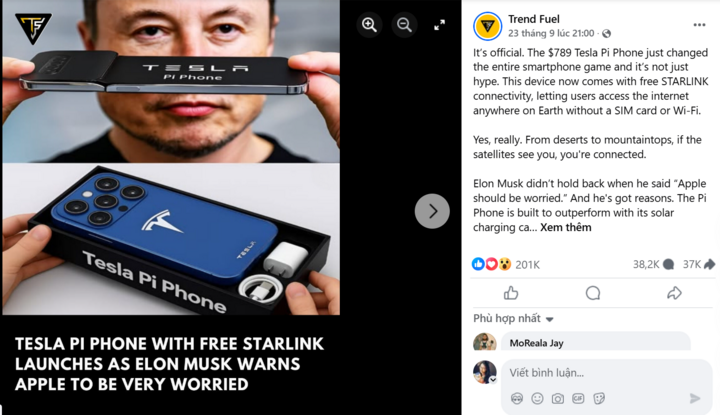
Accordingly, Tesla announced the Pi Phone at a price of $789, which comes with free Starlink connectivity – allowing global internet access without a SIM card or Wi-Fi. Users can go online from the desert to the mountaintop, as long as they are within satellite coverage.
In addition to satellite connectivity, the Pi Phone is also attracting attention with its solar charging, Neuralink synchronization, cryptocurrency mining, and rumors of integration with Tesla vehicle control, AI photography, and live streaming via SpaceX.
However, all of this is still just a rumor and there is no concrete evidence.
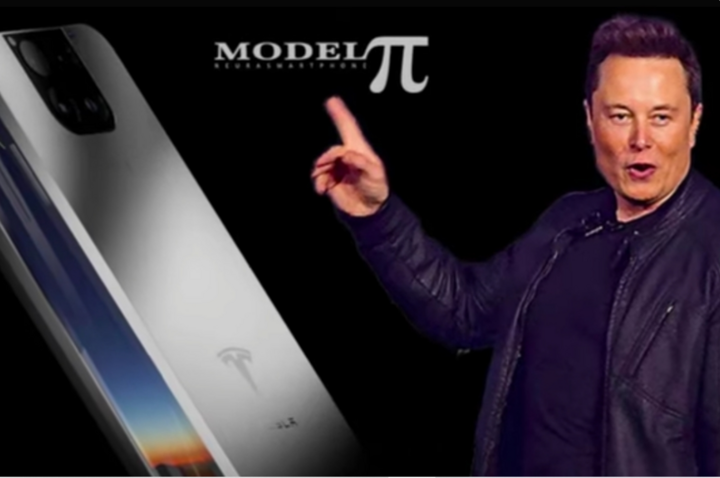
As of September 2025, Tesla has not made any official announcements about a phone capable of charging using solar power or Starlink.
According to the Economic Times, billionaire Elon Musk himself has stated that the company will not manufacture phones unless future circumstances force them to do so. Musk has been asked about smartphones numerous times, and his answer has always been consistent: Tesla would only consider building a phone if Apple or Google restricted Tesla’s apps or services. Currently, Tesla products function normally on iOS and Android, so there’s no reason to launch a separate device.
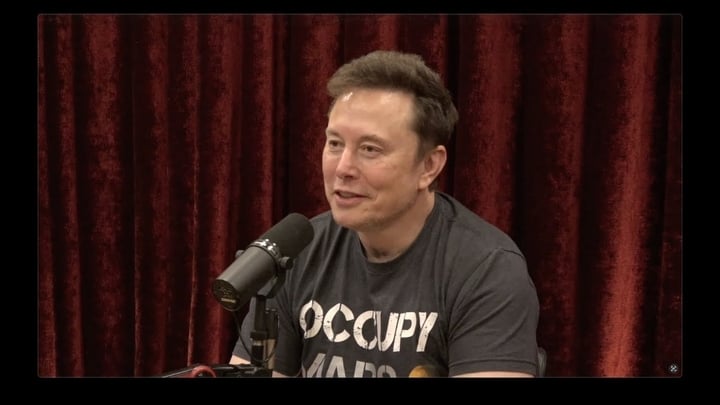
However, when asked if he had ever considered it, Elon Musk offered an explanation regarding Tesla’s ability to create a new device: “We could make a phone because we, you know, like the operating system in Tesla; it’s based on Linux. But we’ve written a huge amount of software on that platform. So, perhaps, Tesla is in a better position than any company in the world to create a new phone that isn’t Android or iPhone. But that’s not something we want to do, unless we’re forced to or something like that.”
Rumors about the “Tesla Model Pi” began to explode in 2021-2022, when several concept images appeared online and spread rapidly because they aligned with Tesla’s vision for the future. Some rumored features included: Direct Starlink connectivity for signal anywhere in the world; Integrated solar panels; Control of Neuralink via a brain-computer interface; and MarsCoin mining, linked to Elon Musk’s vision of colonizing Mars. None of these features have been proven or confirmed by Tesla.
Tesla phone, but not a “Tesla” phone.
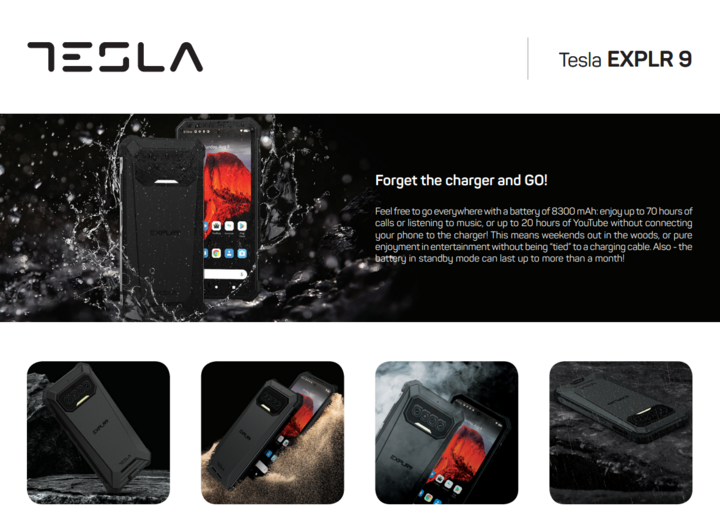
Meanwhile, some rugged phones bearing the Tesla brand have appeared on the European and Asian markets, such as the Tesla EXPLR 9 with a 6.3-inch screen and a 5000 mAh battery. However, these are products of a different company using the Tesla brand under license, and are not related to Tesla, owned by billionaire Elon Musk.
Instead of phones, Elon Musk’s Tesla and SpaceX are focusing on other areas. For example, expanding Starlink’s global satellite internet connection and researching the possibility of direct connectivity to existing smartphones. Tesla is also focusing on electric vehicles, battery storage, and energy solutions.
Analysts suggest that if Tesla enters the smartphone market, it will have to compete directly with Apple, Samsung, and Google — something that doesn’t fit with its current strategy.