

BREAKING: Elon Musk Announces $7,999 Tesla Tiny House — Finally DELIVERY! No Tax & Free LAND! What’s Inside?
The future of housing is here — and once again, it’s being led by Elon Musk. In a stunning new announcement that’s already sending shockwaves through the real estate and tech industries, the Tesla CEO has officially revealed the Tesla Tiny House — a fully sustainable, ultra-modern home priced at just $7,999. But that’s not even the biggest surprise. According to Musk, the company’s new initiative includes “No property tax” and even “Free land options” in selected areas across Nevada and Texas — making this not just a housing innovation, but a full-blown lifestyle revolution. So, what’s really inside the Tesla Tiny House? And how is it possible for one of the world’s most valuable companies to offer a futuristic home for less than the price of a used car? Let’s unpack the announcement that’s turning the entire housing market upside down.
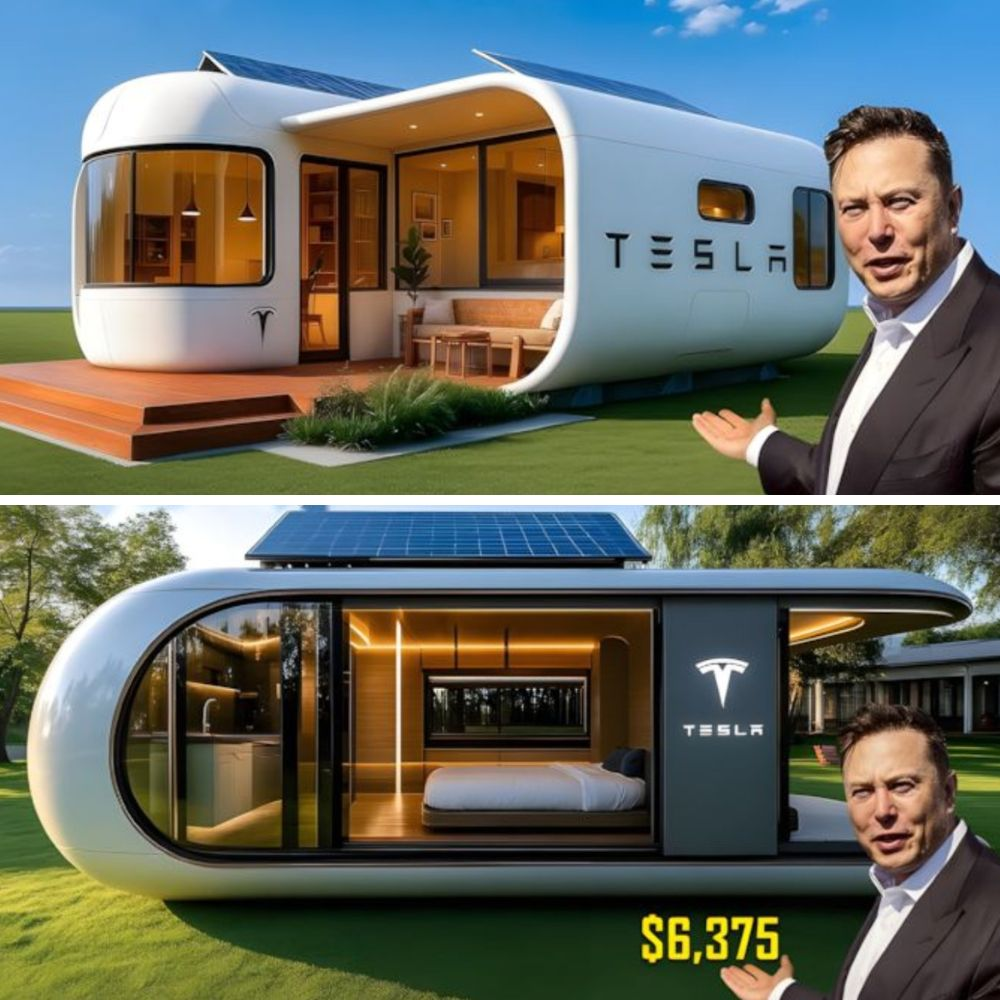
The Tesla Tiny House, officially codenamed Casita, is a 250-square-foot self-sustaining home designed to redefine the way humans live, travel, and consume energy. Built with recycled steel, advanced insulation, and integrated solar panels, Casita is a small but mighty example of Musk’s vision for a “minimalist, off-grid future.” Manufactured at Tesla’s Giga Nevada facility, each Casita is built with the same precision and sustainability standards that Tesla applies to its vehicles. The design features Musk’s trademark blend of function and futuristic simplicity — with curved edges, smart glass windows, and a modular interior that adapts to its owner’s needs. “We spend too much money building big houses we don’t use,” Musk said during the press announcement. “The Tesla Tiny House is about freedom — financial freedom, environmental freedom, and the freedom to live anywhere.” And judging by the early prototypes, that freedom looks extraordinary.
So what do you actually get for $7,999? Quite a lot, it turns out. The Tesla Tiny House is powered entirely by solar energy using a compact Tesla Solar Roof system connected to a Powerwall Mini — a scaled-down version of Tesla’s energy storage unit that can power the home for up to three days without sunlight. Inside, the Casita offers a minimalist but luxurious setup: a foldable queen-sized bed integrated into the wall, a smart kitchenette powered by a 48V system, including an induction cooktop and water-efficient sink, a wet bathroom with a composting toilet and smart water filtration, built-in climate control connected to the Tesla App, allowing users to adjust temperature and lighting remotely, and a smart screen panel that manages energy, lighting, and AI-powered home maintenance. And, of course, it’s all designed with the sleek, futuristic aesthetic Tesla is known for — clean white interiors, hidden storage, and curved architecture that feels more like a spaceship than a cabin. Early reviewers from Tesla’s closed beta program describe it as “a luxury capsule for the modern world.”
The Casita is designed to operate completely off the grid. You can drop it in the desert, on a mountain, or even next to a lake — and it will generate and store its own power. Each Tiny House includes Tesla Solar Roof micro-panels with 8kW generation capacity, a Powerwall Mini battery system capable of 20kWh storage, a Water-from-air system that collects and purifies up to 15 liters of water per day, and an optional Starlink Internet module, providing instant connectivity anywhere on Earth. In essence, it’s a self-contained life unit — something between a traditional home and a next-generation survival pod. Musk himself has been living in a prototype version for over a year near SpaceX’s Starbase in Texas, and he’s repeatedly stated that it’s “the most comfortable and efficient home” he’s ever had.
Perhaps the most controversial part of Musk’s announcement wasn’t the price or the design — it was the offer. According to Tesla’s housing division, early adopters who preorder a Casita in 2025 will receive a plot of land (up to 500 sq ft) in specific “eco-zones” in Nevada and Texas — completely free. The initiative, dubbed the “Solar Settlement Program,” is part of Tesla’s partnership with private land developers and local municipalities aiming to create sustainable, off-grid micro-communities. Musk explained, “You’ll own your house, and you’ll own your energy. But we want you to own your independence, too. That’s why we’re removing the middlemen — no rent, no property tax, no hidden costs. Just you, your home, and the sun.” Tesla’s legal team confirmed that these eco-zones would operate under tax-exempt development agreements, meaning residents would not pay state or property taxes for up to 10 years. The internet exploded with excitement. Some called it “the end of rent.” Others called it “the smartest PR move in history.”
While the Tesla Tiny House is stationary by default, it can also be relocated easily. Using a detachable wheeled base (available for an additional $1,499), the Casita can be hitched to a Tesla Cybertruck or Semi and transported anywhere. The materials used are a combination of recycled aluminum alloy, titanium-laced steel, and biopolymer composites — all designed for longevity. Tesla claims the Casita can withstand Category 5 hurricanes, earthquakes up to magnitude 8, and temperatures ranging from -30°C to +50°C. That’s right — it’s not just a house. It’s a fortress. Even the foundation setup is designed to be easy: Tesla’s new “Mag-Lock Platform” system allows users to anchor the home in under two hours, using self-leveling supports and smart alignment beacons.
Every Tesla Tiny House includes an onboard AI system named T-HOME, a virtual assistant that learns from your habits. It adjusts your environment automatically — from room temperature to power usage — based on your routines. It can also connect directly to your Tesla vehicle, syncing your location, calendar, and even your playlist. Imagine driving your Tesla Cybertruck home, and by the time you arrive, your Casita has already adjusted the lights, prepared the temperature, and brewed your evening coffee. It’s science fiction made real.
According to Elon Musk’s announcement, Tesla has already begun pilot production of the Casita at Giga Nevada. Full-scale production will begin in Q2 of next year, with the first 10,000 units slated for delivery by summer 2026. The preorder list opened just hours after the announcement — and as expected, it nearly crashed Tesla’s servers. Within 24 hours, over 300,000 people reportedly signed up for priority access. Tesla confirmed that buyers can secure a spot with a refundable $100 deposit, and the company will begin site allocation for the Solar Settlement Program by late 2025. “We’re not just selling homes,” Musk said. “We’re building communities — sustainable, self-reliant, and free.”
The Tesla Tiny House isn’t just another product — it’s part of Musk’s grander vision for a multi-planetary civilization. In an earlier interview, he stated that projects like the Casita are “stepping stones for sustainable living on Earth and beyond.” In fact, several design elements — like modular energy storage and water recycling — were adapted from SpaceX’s Mars Habitat research. To Musk, the Casita isn’t about minimalism for style’s sake. It’s about survival — creating scalable housing that could one day exist on Mars, the Moon, or any future human colony. “If we can live sustainably in a 250-square-foot home on Earth,” he said, “we can live sustainably anywhere.”
Social media erupted after the announcement, with fans calling it everything from “The Apple of housing” to “The dawn of affordable freedom.” One viral tweet read: “$7,999 for a house with no bills, no taxes, and solar energy? Elon Musk just broke the housing market.” Others were more skeptical, questioning the feasibility of mass-producing homes at that price without major compromises. But those doubts did little to dampen the enthusiasm. Even real estate experts admitted that, if successful, Tesla’s model could permanently disrupt the global housing industry. “If Tesla delivers on this,” said property analyst Diane Fletcher, “traditional real estate will never recover. This isn’t a house. It’s a movement.”
Tesla has already hinted at a Casita 2.0, a slightly larger 400-square-foot model featuring a dual Powerwall system and expanded kitchen. Musk also teased an optional floating version designed for coastal living, capable of generating energy through both solar and tidal motion. Meanwhile, the company’s website now features a new slogan beneath the Casita preview: “Home is where you decide it to be.” It’s bold, ambitious, and pure Musk — a declaration that the walls around us no longer define our lives. The Tesla Tiny House might look small, but its impact could be enormous. With production underway and delivery approaching, the world might soon see an era where housing isn’t a burden — it’s liberation. Because for the first time, a home doesn’t just shelter you. It sets you free.
Tesla stock slips as supplier guts $2.9 bln battery deal to $7,386
29 December 2025
NEW YORK, December 29, 2025, 09:43 ET — Regular session
- Tesla fell about 2.2% in early trading after South Korea’s L&F slashed the stated value of a battery-material supply deal.
- Investors focused on what the revision signals about Tesla’s in-house 4680 battery ramp and demand for the Cybertruck.
- Traders are watching for Tesla’s next delivery update and any progress on robotaxi plans as year-end liquidity thins.
Tesla shares fell about 2.2% to $464.88 in early trade on Monday, after South Korea’s L&F said the value of a battery-material supply deal with Tesla had shrunk to just $7,386 from an earlier projection of $2.9 billion. Google+1
The revision landed as investors scrutinize whether Tesla’s in-house “4680” battery program is scaling fast enough to support new products and lower costs in 2026, after the stock’s sharp run into year-end. Reuters+1
It also comes in a holiday-thinned market that has amplified moves in big, momentum stocks. Tesla hit a record high last week, Reuters reported, leaving little cushion for any negative surprises. Reuters
L&F, a supplier of cathode material — a key ingredient used in lithium-ion batteries — disclosed the revised deal value in a filing, without giving a reason for the steep cut. Reuters
The company said the 2023 agreement covered high-nickel cathode materials supplied to Tesla and its affiliates from January 2024 through December 2025. Sources and analysts said the materials were intended for Tesla’s in-house 4680 cells. Reuters
Cho Hyun-ryul, a senior analyst at Samsung Securities, said issues with production yields for Tesla’s 4680 batteries and a slowdown in EV demand growth may have contributed to the reduction in orders. “There (is) anxiety about the battery sector overall,” he added. Reuters
Neither Tesla nor L&F immediately responded to requests for comment, Reuters reported. Reuters
Tesla’s 4680 refers to a larger cylindrical battery cell the company has pitched as a cheaper, higher-output design. Chief executive Elon Musk first laid out the mass-production plan in 2020, but also acknowledged challenges scaling a “dry electrode” manufacturing process used to make the cells. Reuters
Tesla currently uses the 4680 batteries in its Cybertruck, which Reuters described as slow-selling despite Musk’s earlier prediction of hundreds of thousands of annual sales. Reuters
The L&F disclosure also highlighted broader strain across South Korea’s EV supply chain, after some battery suppliers reported order cancellations and scaled back joint ventures with U.S. automakers following the end of U.S. federal EV subsidies in September, Reuters reported. Reuters
Tesla’s early slide came alongside broader weakness in tech and AI-linked stocks at the start of the final week of 2025, as investors weighed high valuations and light holiday trading volumes, Reuters reported. Reuters
Autonomy remains another key swing factor for the stock. A Waymo outage in San Francisco this month renewed debate about whether robotaxi operators can handle emergencies at scale, as companies including Tesla and Amazon’s Zoox race to expand, Reuters reported. Reuters
Before the next major company update, investors are watching two near-term milestones: Tesla’s global fourth-quarter delivery figures and Musk’s pledge to move toward unsupervised robotaxis in Austin by year-end, Investors.com reported. Investors
On the macro calendar, traders will also be monitoring minutes from the Federal Reserve’s previous meeting and weekly U.S. jobless claims this week, with U.S. markets closed Thursday for New Year’s Day, Reuters reported. Reuters
Elon Musk unveils Tesla’s $7.999 tiny house that arrives folded on a truck, assembles in hours, becomes a home with optional solar power, a bathroom, and the promise of free land in areas chosen by the company.

Announced for 2026, Elon Musk’s Tesla Tiny House is a $7.999 tiny house with optional solar power, arrives folded by truck, assembles in a few hours, includes a full bathroom, and can come with free land in areas defined by the company in projects in the United States and select markets.
In May 2020, after selling virtually all of the mansions he owned, Elon Musk decided to live in a compact house close to work, putting into practice the concept of minimal housing that now underpins the Tesla Tiny House project, scheduled for release in 2026 with a base price of US$ 7.999.
In this new phase, Tesla plans to treat the house as an industrial product, manufactured at the Fremont Gigafactory on an automated line, shipped folded in regular trucks and assembled in a few hours, with modules of approximately 26 square meters, an option for solar energy, integrated water systems, and a promise of free land in certain areas. pre-defined by the company itself.
How does the $7.999 foldable tiny house work?
Tesla Tiny House is designed to be a house designed as if it were an electronic device, not a conventional work.
— ARTICLE CONTINUES BELOW —
See also other features
- The Caregiver Grant pays one minimum wage per month to help families care for bedridden elderly people at home.
- A sweet, fizzy Brazilian beverage is winning over Chinese consumers, boosting exports by more than 20%, originating in Rio Grande do Sul, stimulating the national grape industry, and bringing the taste of Brazil to the Asian market.
- Northeastern Brazil will register 18,5 million passengers on flights between January and November 2025, experiencing its best period in 25 years.
- A bricklayer in São Paulo won approximately R$ 130 million in a historic Mega-Sena lottery prize and joined the list of millionaires in Brazil.
The walls, kitchen, bathroom, and living areas come pre-assembled from the factory, with electrical, plumbing, and ventilation systems in a plug-and-play configuration, ready for connection in the field.
Instead of flimsy drywall, the structure combines reinforced steel, high-strength concrete panels, EPS insulating foam, and composite layers designed for durability and thermal performance.
The stated objective by Elon Musk It’s about reducing construction to a standardized, fast, and repeatable process, with minimal improvisation on the site.
The structural parts are cast under high pressure, reaching tens of tons in the production assembly, forming rigid modules approximately 8,5 meters long by 4 meters wide.
Each unit, despite its robust design, is light enough to be transported in trucks and shipping containers, enabling high-volume global delivery.
Double transport, assembly in hours, and partnership with Boxable.
Upon leaving the production line, the house transforms into a compact rectangular block, folded to fit into the bed of a Tesla truck.
Semi-standard or standard containerized. Each module weighs approximately 2,38 tons, making transport feasible up to remote locations, far from traditional urban centers.
Tesla has partnered with Boxable, a company specializing in foldable homes, and Elon Musk lived for three months in a compact unit in Texas. to validate the concept of minimum comfort and test the feasibility of this solution on a large scale.
Experience serves as a basis for engineering decisions and for defining weight, insulation, and modularity limits.
At the destination, the installation follows a standardized route.
The modules are unfolded and fixed onto a lightweight foundation, which can use metal piles, precast concrete slabs, or adjustable bases. Electrical and hydraulic connections are made with sealed quick couplings, followed by testing.
Within one to three hours, the unit is functional and ready for occupancy., in contrast to projects that last weeks or months.
Compact interior, zoned layout and space solutions
Although it measures approximately 26 square meters, the Tesla Tiny House is designed to appear more spacious, with ceilings around 2,8 meters high and doors and windows close to 2,3 meters tall, allowing for abundant natural light.
The interior is divided into four main zones: living room, kitchen, bedroom, and bathroom.
The living room, located right at the entrance, accommodates two or three people, with a sofa that converts into a bed, a coffee table, and a panel for a TV or workstation.
The composite flooring was designed to maintain a feeling of thermal comfort in different climates., reinforcing the idea of a house ready for immediate use.
In this compact kitchen, the design includes an induction cooktop, sink, refrigerator, dishwasher, oven, and multi-level cabinets.
A folding table integrated into the counter helps to make the most of every inch. Ventilation and air purification systems reduce odors and humidity, keeping the environment more stable on a daily basis.
The bedroom features a Murphy-style retractable bed that folds into the wall to free up space during the day. The bathroom is small, but includes a shower with a glass door, minimalist sink, water-saving toilet, and temperature and ventilation controls.
Hidden compartments, suspended shelves, and built-in drawers are part of the strategy to avoid wasting internal space.
Solar energy, water, sanitation, and a near-off-grid lifestyle.
The basic version of the tiny house already includes essential water and electricity systems that can be connected to the local grid.
For an additional fee, Tesla offers upgrades including a solar roof and Powerwall battery, all integrated into the brand’s app, allowing for near-independent operation from the electrical grid, depending on consumption.
With the complete package, the Tesla Tiny House can generate and store enough energy for air conditioning, an induction cooktop, a washing machine, and even electric vehicle charging.
Internal reservoirs store potable water, Rainwater harvesting undergoes filtration.Greywater is reused in toilets, and there is a sealed tank for waste treatment, bringing the system closer to a nearly self-sufficient domestic ecosystem.
This configuration aligns with the vision of Elon Musk to reduce emissions and dependence on fossil fuels, aligning electric transport and compact housing within the same technological ecosystem.
In practice, the house becomes part of an integrated infrastructure that includes electric cars, distributed generation, and energy storage.
Free land, business model and impact on the real estate market.
One of the most aggressive aspects of the model is the promise that, for those who do not own land, Tesla will provide free lots for the first two years of the program, in areas designated by the company., reducing the initial cost and traditional bureaucracy of buying property.
The idea is to bring the home buying process closer to the car buying model, with simplified ordering and direct delivery.
In the projection presented by Elon MuskThe customer places the order online, receives the unit in a Tesla Semi truck, and within a few hours, the house is assembled, connected, inspected, and ready for use, without the sequence of permits and lengthy construction processes that characterize the conventional market.
This design is especially aimed at young people, middle-income families, and those trying to escape high rents.
If this approach scales up, Tesla Tiny House could put pressure on the traditional development and construction model, in which the value of the land often exceeds that of the house itself.
For construction companies, the competition would come from an electric vehicle factory that would then compete for the same family budget allocated to housing.
Technical limitations, maintenance, and obstacles to mass-producing the product
The project, however, is far from being a magic solution.
Tesla admits that, despite the use of stainless steel, high-density insulation, and water- and mold-resistant materials, No structure is maintenance-free..
In extreme weather conditions, sealing failures, mold growth, or panel wear can compromise comfort and lead to repair costs.
Thermal insulation is another sensitive point.
If performance is not as expected, harsh winters and very hot summers may require increased use of air conditioning, raising energy bills and reducing the promised efficiency advantage.
In just 26 square meters, privacy also becomes a real challenge, especially for more than one person.
There is also the factor of priorities.
Tesla’s housing division competes internally with already complex areas such as electric vehicles, humanoid robots, and industrial expansion.
So that the tiny house of US$ 7.999 Reaching the global market will require reducing costs for solar panels, batteries, structural materials, and logistics, as well as overcoming different urban planning regulations in each country.
Even so, the mere indication that Elon Musk Tesla and other companies are exploring a line of tiny houses, which has already generated strong interest in the prefabricated home market, reinforcing the trend of tiny houses as a cheaper, modular housing alternative. aligned with discourses of simplicity and sustainability.
Faced with a $7.999 foldable tiny house promising free land and optional solar power, would you choose this compact housing model over a larger, traditional home?