

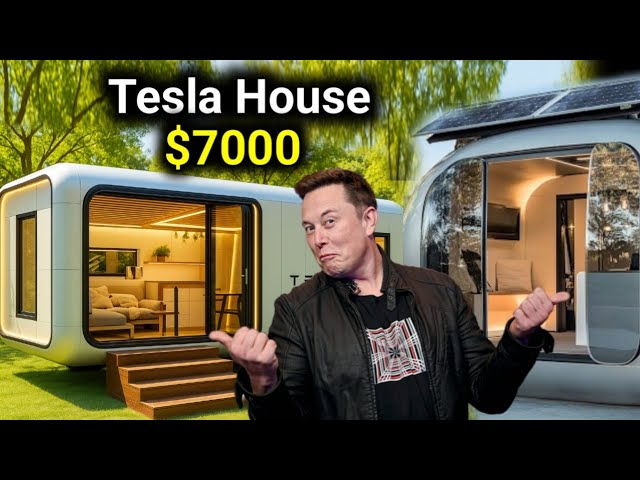
No official $7,000 Tesla tiny house exists; circulating claims on social media/blogs are likely unfounded rumors or misinterpretations of Elon Musk’s private $50,000 Boxabl home or other conceptual/scam products, as Tesla has not officially entered the housing market with such a product. While Tesla integrates energy systems (Solar Roof, Powerwall) into homes, a standalone, ultra-cheap “Tesla Tiny House” is not a real, announced product as of late 2025.
What is being rumored vs. reality:
- The Rumor: A game-changing, ultra-affordable ~$7K-$8K Tesla tiny smart home built in factories is “finally here” in 2025/2026.
- The Reality: These viral stories stem from speculative YouTube/Facebook content, not official Tesla announcements.
- Elon Musk’s Actual Tiny Home: Elon Musk lives in a rented, ~$50,000 Boxabl Casita (approx. 375 sq. ft.) in Texas, not a Tesla-built home.
- Tesla’s Role in Housing: Tesla offers Solar Roofs and Powerwalls which can be integrated into homes, but not complete, mass-produced tiny houses.
Common Misconceptions (from the rumors):
- Tesla factories retooling for tiny homes, using advanced materials, integrating Powerwalls/Solar (all speculative).
- Prices around $7,579 to $14,997 (widely variable across fake sources).
Elon Musk’s Neuralink says its brain chip can now help people move robotic limbs
Copyright Patrick Pleul/AP Photo
Published on 04/12/2025 – 11:09 GMT+1
ShareComments
The device is still in clinical trials.
People implanted with Elon Musk’s Neuralink brain chip can now move robotic arms using only their thoughts, as the device moves beyond allowing people to control computers and smartphones.
In a video posted on X, Neuralink patient Rocky Stoutenburgh – who was paralysed in 2006 – demonstrated his ability to move a robotic arm using his mind, bringing the limb to his face and kissing it.
“Participants in our clinical trials have extended digital computer control to physical devices such as assistive robotic arms,” Neuralink said on X, which is also owned by Musk.
“Over time, we plan to expand the range of devices controllable via Neuralink.”

Neuralink launched to help paralysed people use their personal devices and regain some mobility using only their thoughts. It connects a person’s nervous system to a device known as a brain-computer interface (BCI), which can interpret their brain activity.
ADVERTISEMENT
Related
The device is still in clinical trials, testing the implant’s initial safety and functionality in people with specific medical conditions that limit their mobility.
As of September, Neuralink had implanted its device in 12 people since January 2024. The first participant was a man who was paralysed after a spinal cord injury, and the implant made it possible for him to play video games and chess.
Other participants have had spinal cord injuries or amyotrophic lateral sclerosis (ALS), which over time affects people’s ability to move their arms, legs, and body.
Musk said more than 10,000 people have signed up for Neuralink’s patient registry, hoping to participate in trials for the device.
Neuralink is one of several companies working on BCIs. Other studies are exploring their use for people with cerebral palsy, dementia, stroke, and other health issues, according to a US clinical trials database.